FDEO HUD Small Cities CDBG DHR Project File No.: 2023-5606 | 311 SW 3rd Street, Stuart, Florida 34994-Housing Rehabilitation
Do Not Trust the Guardians of Public Trust – Part 1
This is not a private matter! Federally funded programs are matters of public concern!
We periodically update this article.
Under the federally funded Small Cities Community Development Block Grant (CDBG) Housing Rehabilitation Program, our our historic home project includes but not limited to: a substandard roof replacement, the complete failure to install a required ridge vent system, unauthorized by the Building Department installation of wrong hurricane ties, altered records and falsified documents, the homeowner’s forged signature on Change Order, fraudulent lien — all while the City and Guardian CRM approved payments for incomplete and non-compliant work.
We were denied our requests to reopen the roof permit and complete the work, as well as our requests for financial records. Despite our repeated complaints, we were even deprived of the contractor’s final affidavit before the City and Guardian CRM authorized disbursement of taxpayer funds to the contractor Patriot Response Group even for work that was never performed. This case raises serious questions about oversight, accountability, and the integrity of a HUD funded CDBG Housing Rehabilitation programs.
Who is Who:
Ms. Gandhi-Savdas, Community Redevelopment Agency (CRA) Executive Director and The City of Stuart CDBG Project Manager for the City with the authority to act on the City’s behalf with respect to all aspects of the Project.
Mr. Mortell, City Manager (now former).
Mr. Jenkins of Guardian Community Resource Management, Inc., a firm contracted by the City of Stuart to assist with the CDBG Program management. Under the contract between the City and Guardian Community Resource Management Inc., Mr. Jenkins’s primary duties include project delivery services and construction oversight, contractor vetting and program management. He conducts orientation sessions for contractors and vendors, conducts site inspections for compliance, he reviews mortgage & construction contracts, creates/tracks project construction budget; reviews, monitors, approves construction and contractor pay authorizations. And it is also stated that Mr. Jenkins is “well versed in the latest building standards and codes.”
Patriot Response Group, LLC, the CDBG general contractor vetted, approved and supervised by the City of Stuart and Guardian CRM, Inc. (one of only two bidders “reviewed” by Mr. Jenkins of Guardian CRM, Inc.)
On December 19, 2023, out of only two bids provided to us by the City and Guardian CRM, Inc., we selected the bid submitted by Patriot Response Group.
In response to our inquiry about the contractors, Guardian CRM, Inc. stated that Patriot Response Group had a good record, having worked with them on many CDBG HR projects.

The CDBG scope of work for the roof includes “The ridge vent system…” and “The entire NEW ROOF SYSTEM shall conform to building code…” The paperwork also states that bid estimates must be based on the work write-up provided by the City.


The contractor, Patriot Response Group, was responsible for all applications, plans, drawings, product approvals, etc.
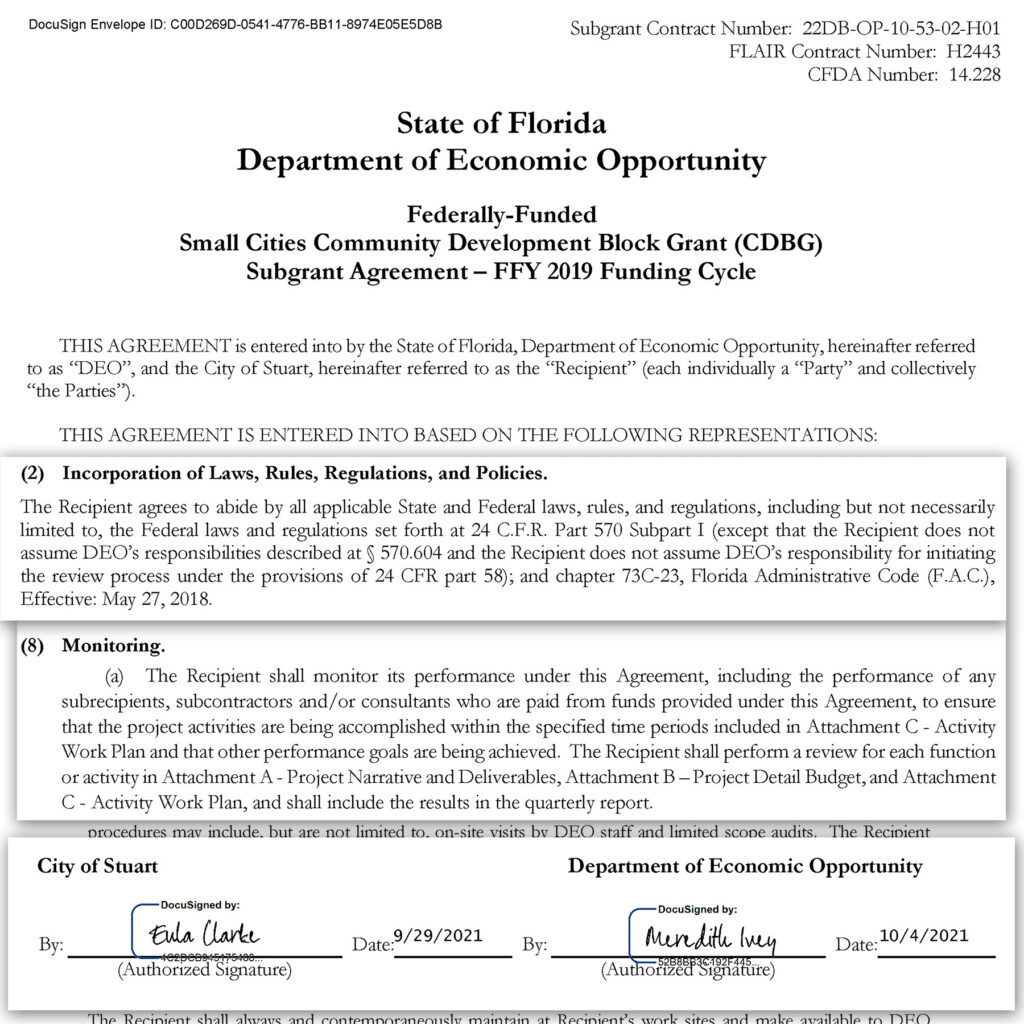
The City of Stuart was responsible for monitoring and supervising the contractor and Guardian Community Resource Management, Inc., in accordance with the State of Florida Department of Economic Opportunity (DEO) Federally-Funded Small Cities Community Development Block Grant (CDBG) Subgrant Agreement—specifically under the section on Incorporation of Laws, Rules, Regulations, and Policies. Mr. Mortell was the City Attorney at the time Mayor Eula Clarke signed the Subgrant Agreement.

On May 22, 2024, the contractor Patriot Response Group proceeded with the deck replacement, hurricane ties installation, and Polystick waterproofing underlayment installation. The City of Stuart Building Department passed the “Dry-in” inspection the following day, on May 23, 2024.


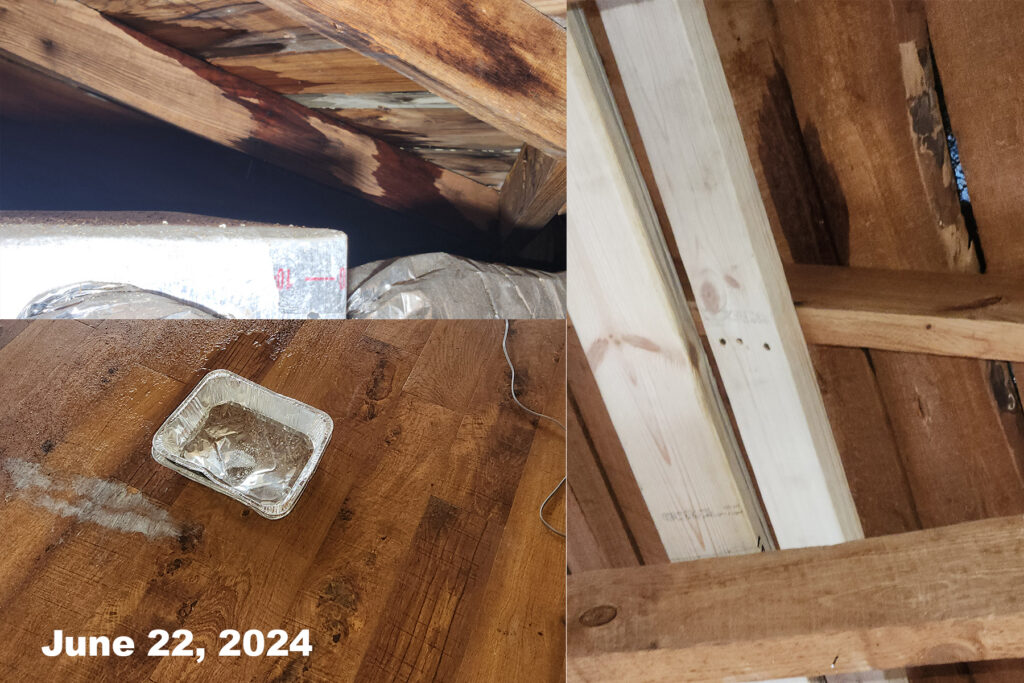
On June 12, 2024, the deck replacement and waterproofing underlayment installation failed, resulting in multiple leaks in the roof. The underlayment wrinkled and the seams lifted.


We do not know whether the roof sheathing inspection prior to the dry-in inspection was performed by the City of Stuart Building Department, or whether it was included in the “dry-in” inspection noted on the building permit (per Florida Building Code 110.3 Required Inspections).
The contractor, Patriot Response Group, submitted a dubious “Reroof Sheathing Affidavit” that was notarized by Vance Olvey, an employee and authorized representative of the company who also signs contracts and change orders. Vance Olvey is the brother of Michael Olvey, the owner of Patriot Response Group, LLC. Under Florida Statute §117.107(11), a notary is prohibited from notarizing the signature of certain immediate family members, and §117.107(12) further prohibits notarization when the notary has a financial interest in the underlying transaction. Given Vance Olvey’s employment with and familial relationship to the company’s owner, this notarization raises serious questions of improper conduct, conflict of interest, and potential invalidity of the affidavit. The City of Stuart Building Department appears to have relied on this questionable document when approving the “dry-in” inspection.

The contractor left the damaged deck boards and holes in place and simply covered them with the Polystick roof underlayment.


According to Polyglass U.S.A., Inc., Polystick manufacturer, : “Unless the substrate surface is flat, voids may occur which will be hard to seal and may not render a permanent, waterproof roof. It is the installer’s responsibility to ensure that substrate conditions permit a wrinkle and void-free installation. Any voids occurring may have to be sealed with a heat gun or other suitable mastic. If full roof coverage application is desired, proper venting of the structure is recommended. Consult a design professional for proper venting requirements. Applications involving non ventilated attics or sheathing with radiant barriers, an anchor sheet is recommended to allow venting and prevent the creation of a double vapor barrier
condition.
Our roof ridge vent has remained sealed since May 22, 2024. We have suffered from excessive heat and unpleasant odors due to the lack of proper roof ventilation. The roof underlayment was off-gassing and releasing chemicals for several days. On June 12, 2024, at 10:17 a.m., we reported the roof leaks via group message to the contractor and to Project Manager/Director of Construction Antonio Jenkins of Guardian CRM, Inc.

On June 13, 2024, in the late afternoon, the contractor stopped by and told us they knew nothing about the roof leaks. They stated that the Building Department had passed the “dry-in” inspection and that they planned to install metal over the failed deck replacement and underlayment, which they claimed would stop the leaks.
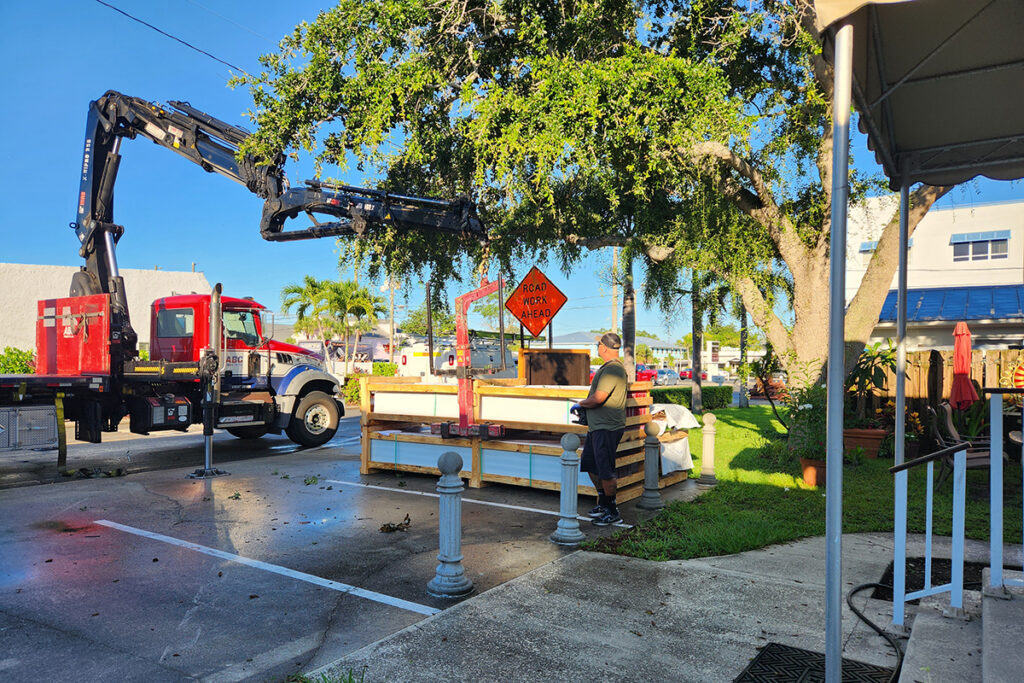
The next day, on June 14, 2024, at 7:40 a.m., the contractor delivered three crates of roof metal.
On June 14, 2024, we sent a message to Mr. Jenkins of Guardian CRM, Inc., expressing our concerns about the contractor. We also shared a negative review of Patriot Response Group left by Lisa Bergeron, a disabled 60 y.o. woman from Fort Pierce on buildzoom.com. Mr. Jenkins responded that he could not comment on FEMA projects and again assured us that he had completed many projects with Patriot Response Group. That same day, we also informed Mr. Jenkins that Patriot Response Group had installed the hurricane ties incorrectly.

At 6:11 p.m. that same day, we messaged Mr. Jenkins that Patrick Jordan of Patriot Response Group was unaware of the roof leaks and missing hurricane ties we had reported and was insisting on installing the metal roof over the leaking underlayment on June 21. We also told Mr. Jenkins, “We are scared of these people—they talk over us—and we do not trust them.” Mr. Jenkins responded that he had spoken to everyone and confirmed the re-installation of the failed Polystick.


The second roof deck replacement took place on June 21, 2024. Dawn Cobb, administrator for Guardian CRM, Inc., and Patrick Jordan, superintendent for Patriot Response Group, were marking the roof boards for replacement. Some boards with black residue from the failed Polystick installation of May 22, 2024 (which failed on June 12, 2024) were in satisfactory condition but were broken during removal and thrown on the ground. The roof work that day was performed by a man named Bernardo and two young men. Bernardo told us he was not even a roofer, but a repairman.

Photos below: The Polystick underlayment installed on May 22, 2024, was removed. The decking boards show black sticky residue from the underlayment.

Photos below: Comparison of the roof deck. One photo was taken on May 22, 2024, another on June 21, 2024, along with a close-up of the boards. The same roof area received the same work — and, notably, there were no leaks in that particular area.

The roof leaked again in several places on July 22, 2024, due to punctures in the underlayment. The “stepped-on” roofing cap nails were removed, and the punctures were repaired the same day by Bernardo, who left us his cell phone number.
We did not see the roof ridge vent system among the delivered metal roofing materials, which of course concerned us. We contacted Antonio Jenkins of Guardian CRM, Inc., and after the contractor called, we were assured that the roof ridge vent system would be installed.
The metal roof installation took place on June 28, 2024. The roofing crew stated they had never performed a “standing seam installation” before. They were also concerned that the metal would not lay flat because some boards were swollen.


The roof passed the final inspection on July 2, 2024. The City Building Department official left us the roof permit record, which showed:
– Dry-in on 5/23/2024 – BBD Pass
– Roof in progress on 6/28/2024 – BBD Pass
– Roof Final on 7/2/2024 – BBD Pass
There is no record of a dry-in inspection for the second roof deck replacement that took place on June 21, 2024, prior to the metal installation on June 28, 2024.

Roof sheathing and dry-in inspections are a critical component in ensuring a safe and durable roofing system, preventing future damage from rain and wind.

The contractor installed the new metal roof directly over damaged and swollen deck boards. This shoddy practice raised serious concerns about the long-term integrity, structural soundness, and weather resistance of the roof. Installing metal roofing over compromised decking violates standard building practices and the Florida Building Code requirements for proper substrate preparation, potentially leading to premature failure and safety issues.
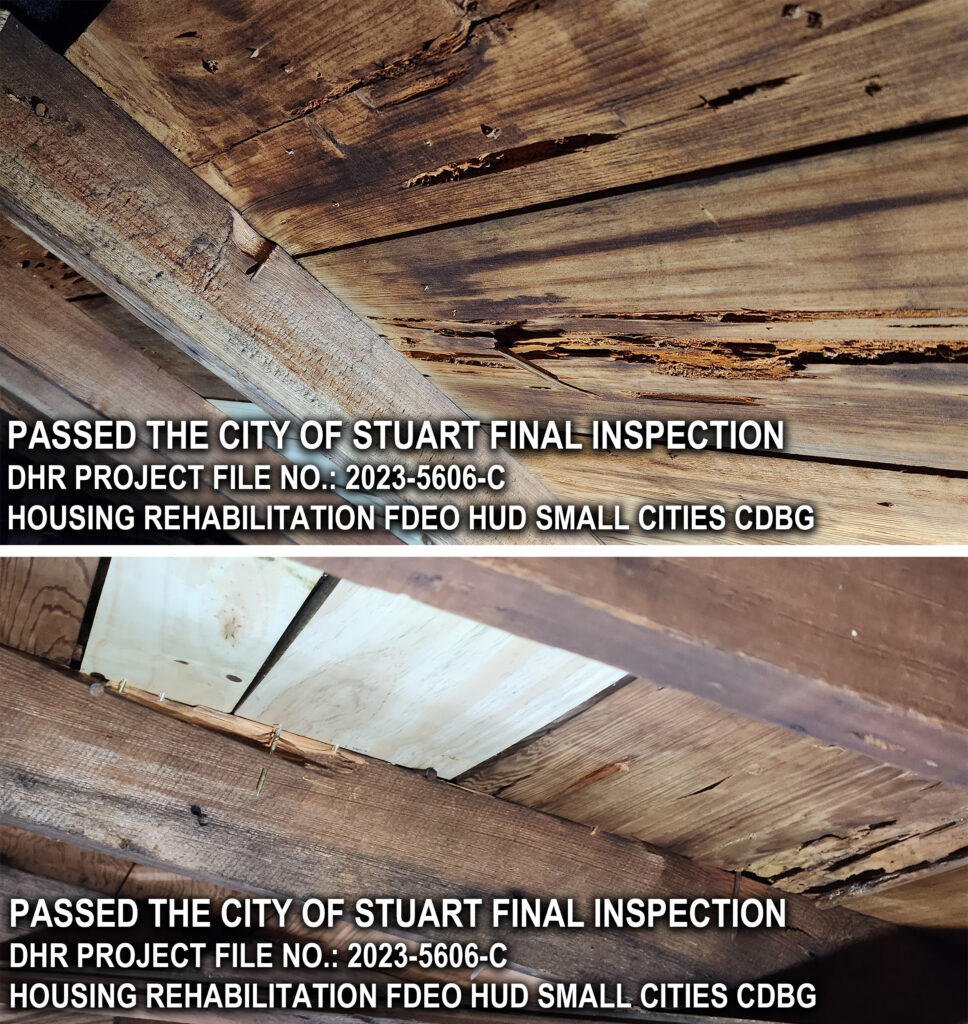
Neither were the damaged rafters addressed, nor were the inadequate repairs inspected.


In our complaint on July 19, 2024, at 10:17 a.m., we notified the City of Stuart CDBG project management (the City CRA and Guardian CRM): “Our roof fascia is missing metal wrapping on one side of the building. The fascia is also not properly secured, and we are concerned it will become the roof’s peeling point during severe storms.”
The City ignored our complaint.
Later, wind gusts ripped off the front fascia—which had not been attached at all—and bent and lifted the metal roof corner boxes.
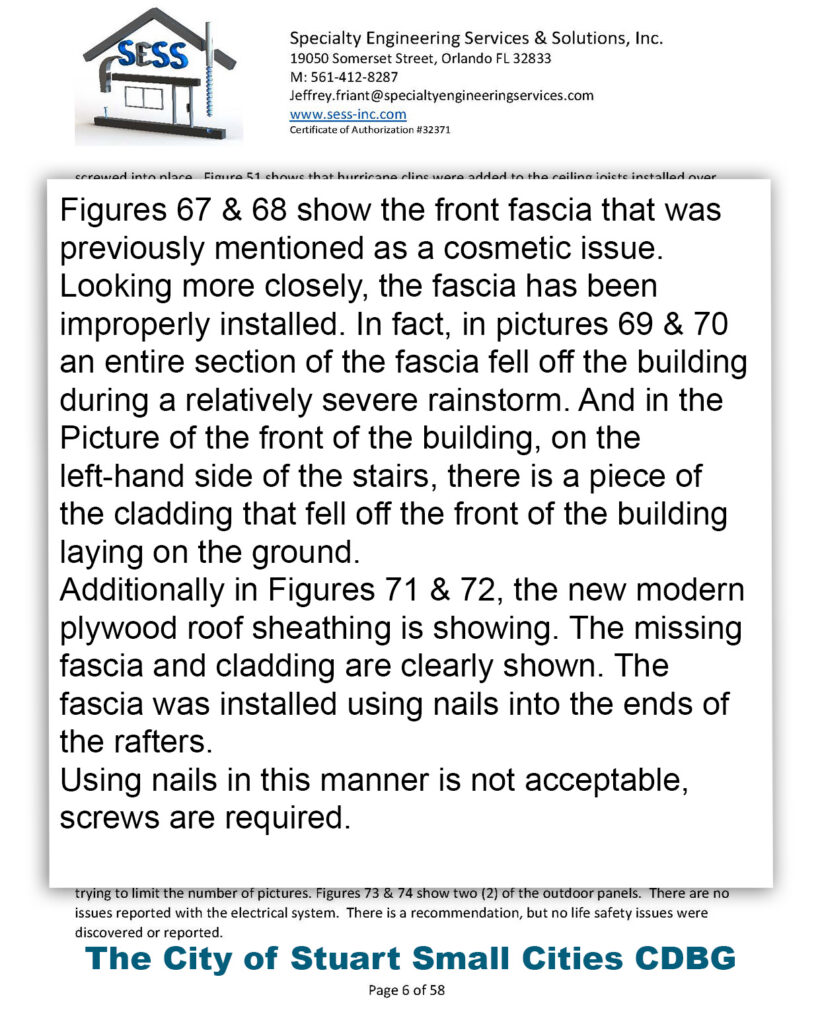
Specialty Engineering Services & Solutions, Inc. stated in their report: “Figures 67 & 68 show the front fascia that was previously mentioned as a cosmetic issue. Looking more closely, the fascia has been improperly installed. In fact, in pictures 69 & 70 an entire section of the fascia fell off the building during a relatively severe rainstorm. And in the Picture of the front of the building, on the left-hand side of the stairs, there is a piece of the cladding that fell off the front of the building laying on the ground.
Additionally in Figures 71 & 72, the new modern plywood roof sheathing is showing. The missing fascia and cladding are clearly shown. The fascia was installed using nails into the ends of the rafters. Using nails in this manner is not acceptable, screws are required.”


The Fake Roof Ridge Vent System
We could not understand why so much heat was entering the dwelling, and why it was extremely hot inside the attic. When we pulled out the mesh along the roof ridge, we discovered that no roof ridge vent system had been installed at all! he contractor eliminated our functioning roof ridge vent system and never replaced it with a new one, in direct violation of the CDBG scope of work.
Below are photos of our roof with the functioning ridge vent system before the roof replacement by Patriot Response Group (May 22, 2024 – June 28, 2024 — over a month). The photos of our shingle roof with the ridge vent system were taken by the wind mitigation and home inspector on August 24, 2022.

The contractor sealed the existing roof ridge vent and covered it with a strip of vent mesh from underneath in the attic to create the appearance of a “functioning” roof ridge vent system. Does this look like the contractor “faked” the roof ridge vent system instead of properly installing it as required by the CDBG scope of work?

After a meeting with the City of Stuart Building Department and a review of our roof permit file (the documents were also provided to us electronically), we discovered that Patriot Response Group never submitted the City of Stuart CDBG HR scope of work to the Building Department. The building permit application for the roof did not even reference the CDBG HR program scope of work. Instead, Patriot Response Group uploaded a dubious “price list” that included charges for the removal and installation of items we never had on our roof. Remarkably, even this “price list” mentioned “the roof ridge vent system replacement.”
In his January 16, 2026 email, City Attorney Baggett stated:
“The specifications of the ridge vent system was not part of the permit process before the Building Department. Since the ridge vent system is in the revised Scope of Work, it will be part of the permit process in the future.” This statement raises serious questions. City Attorney Baggett has access to the 2023 City of Stuart CDBG Scope of Work for our project, which explicitly included the roof ridge vent system
This statement raises serious questions. City Attorney Baggett has access to the 2023 City of Stuart CDBG Scope of Work for our project, which explicitly included the roof ridge vent system:
“The ridge vent system shall consist of a perforated ‘Z’ flashing along the ridge at the existing …”
City Attorney Baggett was also included in our September 26, 2024, 12:31 PM correspondence, in which we wrote: “The City of Stuart Building Department passed the final inspection of the incomplete roof with a fake roof ridge vent system, but the City Manager, who is also a Florida Bar member and was notified about this, states, ‘we cannot do reinspections.’”
In that same correspondence, we cited Article 5 – Supervision of the CDBG rehabilitation contract with Patriot Response Group, prepared by Guardian Community Resource Management on the City’s behalf.
Article 5.3 states:
“Any work which does not conform to the Contract Documents shall be rejected by the Owner.”
The contract further requires owner approval of payment draw requests and owner signatures on change orders before modifications to the project may proceed.
If the ridge vent system was included in the original CDBG Scope of Work, why was it not part of the permit process? If the roof work was incomplete, how was the permit closed on July 2, 2024? Why was it not corrected before taxpayer funds were released?
What makes this situation with the roof ridge vent system particularly troubling is that three City officials appear to have provided statements that are even difficult to reconcile with one another.
The Scope of Work is the foundational project document that identifies the specific rehabilitation activities approved for funding, inspection, and payment under the federally funded program. Without the CDBG Scope of Work, how could the Building Department verify that the permitted work matched the work authorized under the grant? How could inspectors determine whether the work being performed complied with the approved rehabilitation specifications? And how could City officials later certify project completion and authorize payment if the Building Department did not have the complete CDBG Scope of Work?
We also discovered that Patriot Response Group filed a falsely notarized Notice of Commencement with the Martin County Clerk of Court on April 1, 2024. We contacted the Clerk’s office and filed a complaint with the Governor’s Office Notary Section. You are welcome to read the correspondence and the Conclusion of Investigation below.
On August 14, 2024, at 9:49 AM, we sent an email to City Manager Mr. Mortell, Lou Hatten CBO, BCA, Building Official, and Ms. Gandhi-Savdas, CRA director and The City of Stuart CDBG Project Manager, requesting the City to reopen Building Permit BP-24-684, “The roof is not complete and poses a safety risk. No itemized documentation was provided by the contractor to justify the $19,090 Valuation. The roof ridge vent was not installed. The manufacturer of the Simpson Strong-Tie H3 hurricane tie connectors confirmed the incorrect installation of the hurricane ties. The roof 2X6 sub-fascia and aluminum fascia are attached not according to the Florida Building Code. The fascia on one side of the roof is not completed at all, etc. Building Permit BP-24-684 doesn’t reflect all required inspections.
On August 14, 2024, 5 hours later, the Building Department removed files, altering the records activity on the federally funded program administered by the State. FloridaCommerce provided us with the permit activity records attached to the email dated April 5, 2025.
According to the permit activity log, Building Official Bruce Duncan removed the following attachments from Permit Record BP-24-653 on August 14, 2024:
-Manufactured Roof Truss Drawing (removed at 3:41 p.m.)
– Letter of Authorization for Agent (removed at 3:41 p.m.)
– Revision (removed at 3:42 p.m.)
-Florida Approved Products List (removed at 3:42 p.m.)
We received these permit activity records as attachments through correspondence between FloridaCommerce and the structural engineer on April 4, 2025, at 12:20 PM EDT, when FloridaCommerce copied us on the communication.
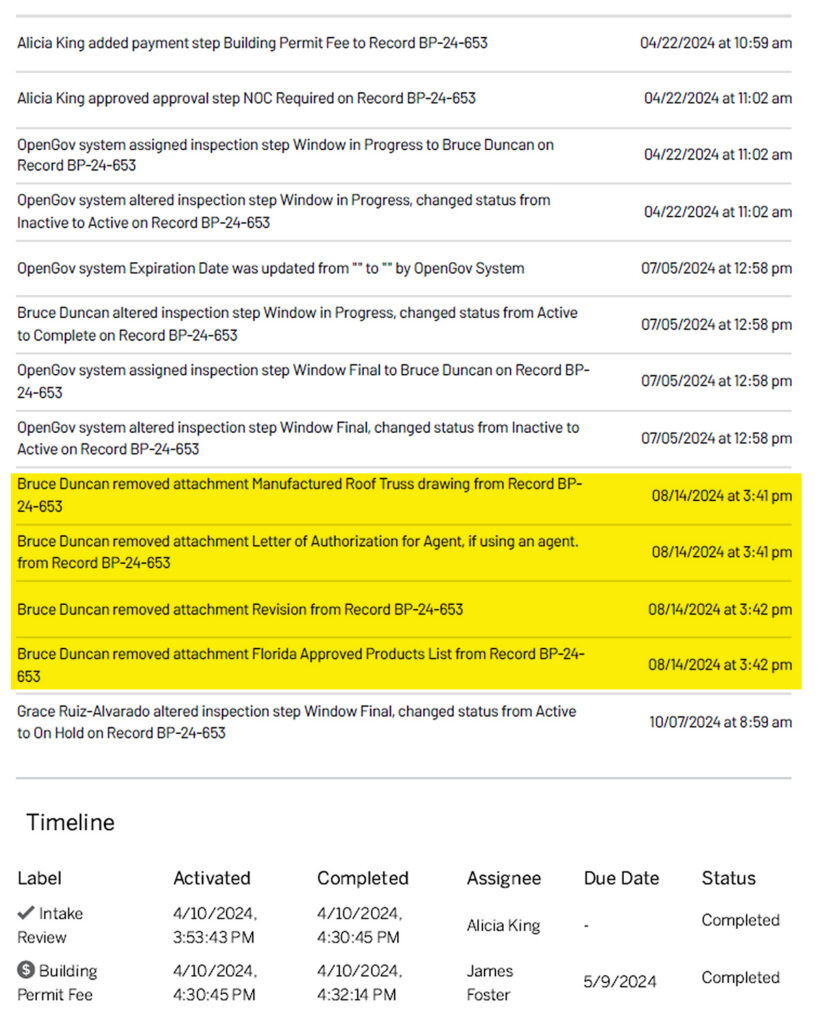
On January 16, 2026, at 4:57 PM, City Attorney Baggett stated in his email: “Mr. Duncan did not remove a document. Mr. Duncan removed an unnecessary workflow requirement in the OpenGov System for a re-roof in order to close out the permit.”
Mr. Baggett, as the City Attorney, is familiar with the Subgrant Agreement between FloridaCommerce and the City of Stuart. That Agreement requires the City, as the Recipient of federal funds, to maintain records demonstrating compliance with program requirements, monitor contractors and consultants, maintain housing rehabilitation case files documenting project completion, and retain enforcement and monitoring records for at least six years after closeout of the subgrant. The City is also bound by the federal recordkeeping requirements applicable to CDBG programs, including 24 CFR Part 570 and the documentation requirements of 24 CFR § 570.506.
Subgrant Contract Number: 22DB-OP-10-53-02-H01
(5) Records.
(e) The Recipient shall retain sufficient records on-site to show its compliance with the terms of this Agreement, and the compliance of all subrecipients, contractors, subcontractors, and consultants paid from funds under this Agreement, for a period of six years from the date DEO issues the final closeout (as defined in rule 73C-23.0031(14), F.A.C.) for this award or for a period of three years from the date that DEO closes out the CDBG program year(s) from which the funds were awarded by the U.S. Department of Housing and Urban Development, whichever is later.
(f) The Recipient shall maintain all records and supporting documentation for the Recipient and for all subrecipients, contractors, subcontractors, and consultants to be paid from funds provided under this Agreement, including documentation of all program costs, in a form sufficient to determine compliance with the requirements and objectives of the Scope of Work and all other applicable laws and regulations.
Building permit records, contractor submissions, revisions, inspections, and supporting permit documents are not trivial administrative paperwork – they are critically important for detecting and preventing contractor fraud, collusion, waste, abuse, and improper payments in CDBG housing rehabilitation programs. Permit records serve as an independent, legally significant cross-reference to contractor invoices, scopes of work, inspections, change orders, certifications, and requests for payment. They are part of the documentation used to verify compliance, construction activities, inspections, and the expenditure of taxpayer funds under a federally funded program. Their preservation and availability are essential for transparency, accountability, audits, and public confidence in the administration of the program.
If the Manufactured Roof Truss Drawing was unnecessary, why was it submitted in the first place, and why was it later removed from the permit record? This question is particularly important given that, on November 25, 2024, after the contractor had already been paid; City Manager Mortell stated that our historic roof contained damaged trusses. Why were we, the homeowners, not timely notified of any concerns involving roof trusses? How could the Building Department close the permit while allegedly knowing that damaged roof trusses remained unaddressed? Were the truss drawing related to those concerns?
The permit records also show that a “Letter of Authorization for Agent” was removed from the permit file. In Florida, a Letter of Authorization for Agent is a legal document that allows a property owner or licensed contractor to designate a representative to apply for permits, sign permit-related documents, request inspections, or otherwise act on the owner’s behalf before the local building department. Such a document typically requires signatures and, in many cases, notarization before being filed with the permitting authority.
We, the homeowners, did not sign any such authorization letter. If a Letter of Authorization for Agent was submitted to the permit file, who signed it? Who authorized its submission? Why was it included in the permit record, and why was it later removed? Or was it one more document with the homeowner’s forged signature?!

The following day, on August 15, 2024, at 1:58 PM EDT, after the Building Department altered permit activity records, Guardian Community Resource Management (Guardian CRM) denied our written request, originally submitted on July 24, 2024, for a fully itemized final bill and supporting documentation, including a copy of Change Order #1, before taxpayer funds were released.
In the same email, Guardian CRM made what we perceived as a veiled threat of liens if we refused to sign documents authorizing the release of CDBG funds to the contractor. Those documents stated that “the consideration provided and received by all is fair, just and reasonable and that no further consideration, compensation, or obligation will be due, payable, or owing with regard to the Contract and/or termination of the contract.”
The email was copied to City Manager Michael Mortell and CRA Director Pinal Gandhi-Savdas. Verbatim excerpts from Guardian CRM’s email stated:
“The only action being taken at this time is the official dissolution of the agreement between you (the Hamiltons) and the contractor (Patriot Response Group). This will allow: (1) avoidance of any mechanical liens that the contractor will have a legal right to impose should just due payment not be rendered… Itemized invoice from Patriot Response Group: such an invoice will not be generated from the contractor until a dissolution agreement is agreed upon by the applicable parties, signed, and approved.”
These statements raised significant concerns for us. We were being asked to sign documents declaring the payment to be “fair, just, and reasonable” while simultaneously being denied access to the underlying financial records, itemized invoices, and supporting documentation necessary to independently evaluate the contractor’s claim for payment.
Rather than fulfilling the City’s oversight responsibilities, City Manager Mortell, in a September 5, 2024, 8:13 AM EDT email copied to the City Commissioners and to us, again denied the City’s responsibility to oversee the federally funded program and instead attempted to persuade us to sign the disputed dissolution documents. As City Manager Mortell wrote:
“Essentially, the City of Stuart does not serve as the contractor or supervisor of the program… It does not matter where the funding came from… If you sign the papers — even under protest…” At the same time, the City Manager wrote: “…the City has already done the inspections. … we can not just go back and change the inspections. It is very complicated.”
We declined to sign the documents releasing payment (taxpayer funds) to Patriot Response Group for work that wasn’t even performed, which the City presented as “just, fair, and reasonable.”
In an email dated October 7, 2024, at 9:17 AM EDT, sent to us, the City Commissioners, City Manager Mortell, City Attorney Baggett, and the City Building Department, CRA Director Pinal Gandhi-Savdas acknowledged in writing:
“We understand that the contractor did not install the roof ridge vent system… The new contractor of your choice will pull a new permit for the vent system and it will be inspected by the Building Department.”
In the same email, she also stated:
“Patriot is NOT getting paid for something they didn’t install.” The statement was false.
And in the same email from CRA Director Pinal Gandhi-Savdas our requests for re-inspections and to reopen the roof permit to complete the roof were again denied in writing as she wrote:
“The permit #BP-24-684 was for a new roof and that was inspected and passed by the Building Department. That permit has been closed and will remain closed.”
The City’s own records therefore acknowledge that the roof ridge vent system required by the 2023 CDBG Scope of Work was not installed and would need to be completed by another contractor under a separate permit.
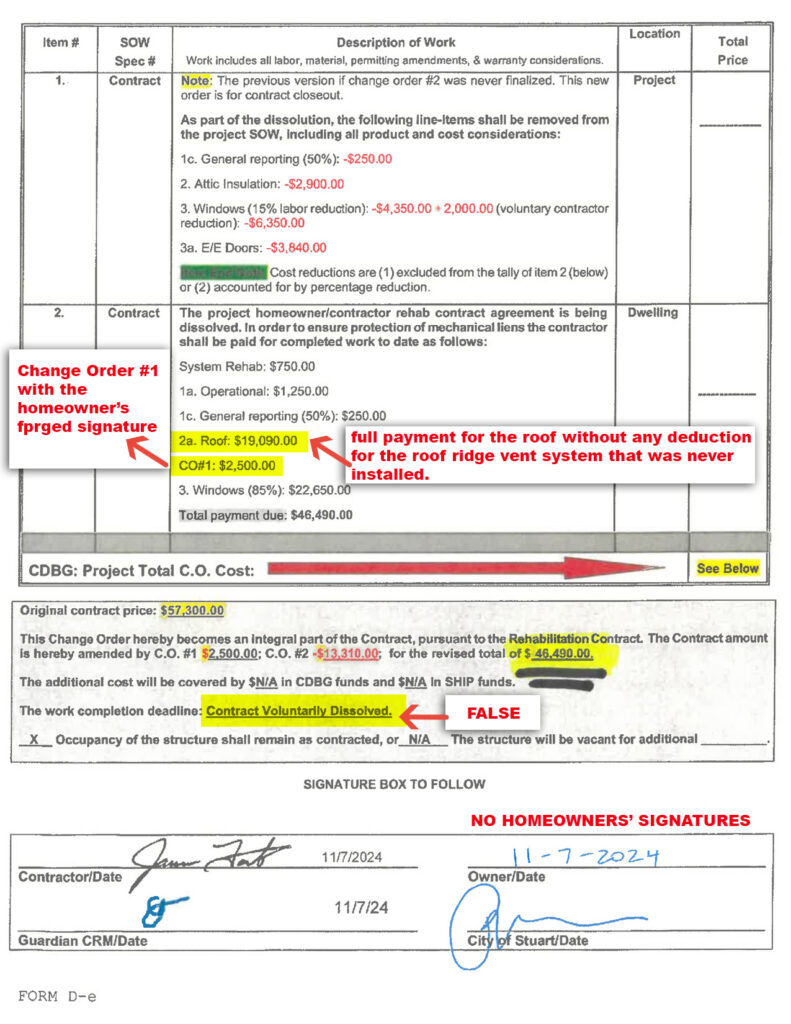
However, the City certified the roof replacement work as 100% complete and authorized full payment for the roof without any deduction for the roof ridge vent system that was never installed. The City also authorized payment under Change Order #1, a financial document bearing the homeowner’s allegedly forged signature, including payment for work that had not been inspected.
The release of CDBG funds requires approvals, certifications, and authorizations by government employees and officials who are responsible for reviewing documentation, verifying compliance, and authorizing the expenditure of public funds. The certification and release documents were executed by the City of Stuart, Guardian Community Resource Management, Inc., and Patriot Response Group, the contractor, without the homeowners’ signatures. The document “new order for contract closeout” is also falsely stating “Contract Voluntarily Dissolved”
The Change Order Preface and Terms of Dissolution sent to us by the City CRA Director November 25, 2024 at 11:29 AM contained two falsified dates.
The Contract for Rehabilitation Work NTP was issued on January 22, 2024. We signed the Contract and NTP, and it was notarized by Dawn Cobb, Guardian CRM Administrator, on March 13, 2024.
The document states that the parties “mutually agree to dissolve and cancel the contract effective immediately on this the 15th day of August, 2024.” However, Patriot Response Group had not performed any work on our property since July 13, 2024, and was completely removed from our project on July 26, 2024. In our email to the City of Stuart CDBG project management on Friday, July 26, 2024, at 2:23 p.m., we wrote: “According to the Florida Statutes, we do not have to close the permit with the City of Stuart to release Patriot Response Group. No one from their company or their proxies is allowed on our property anymore. We feel intimidated and unsafe. On June 20, 2024, we already expressed our concern and mentioned through phone messages that ‘we are very scared of these people.’ We want the permit left open.”
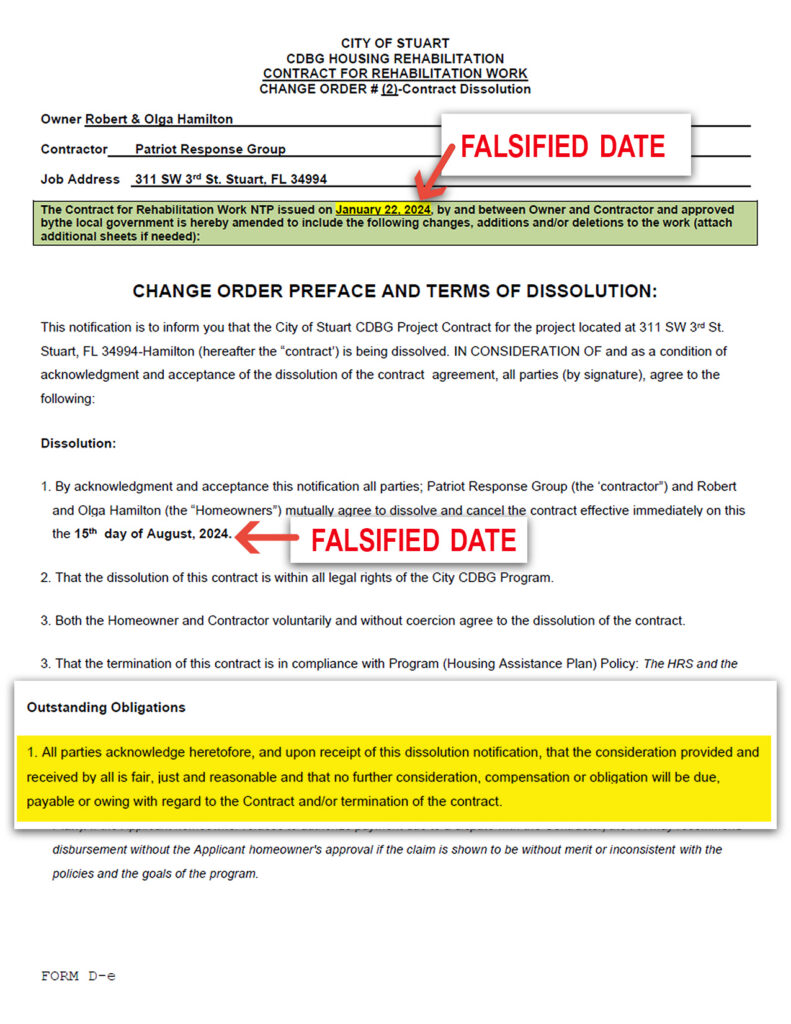
The Change Order Preface and Terms of Dissolution that the City wanted us to sign — without first providing the requested financial records for our project — also stated: “All parties acknowledge heretofore, and upon receipt of this dissolution notification, that the consideration provided and received by all is fair, just and reasonable and that no further consideration, compensation or obligation will be due, payable or owing with regard to the Contract and/or termination of the contract.”
We refused to participate in what appears to be a cover-up of improper payments and did not sign the documents. Nevertheless, the City of Stuart proceeded without our signatures. On November 8, 2024, Executive Administrative Assistant and CRA Specialist Jordan Pinkston, CRA Director Gandhi-Savdas, and City Manager Michael Mortell requested payment to Patriot Response Group from CDBG Fund #105.

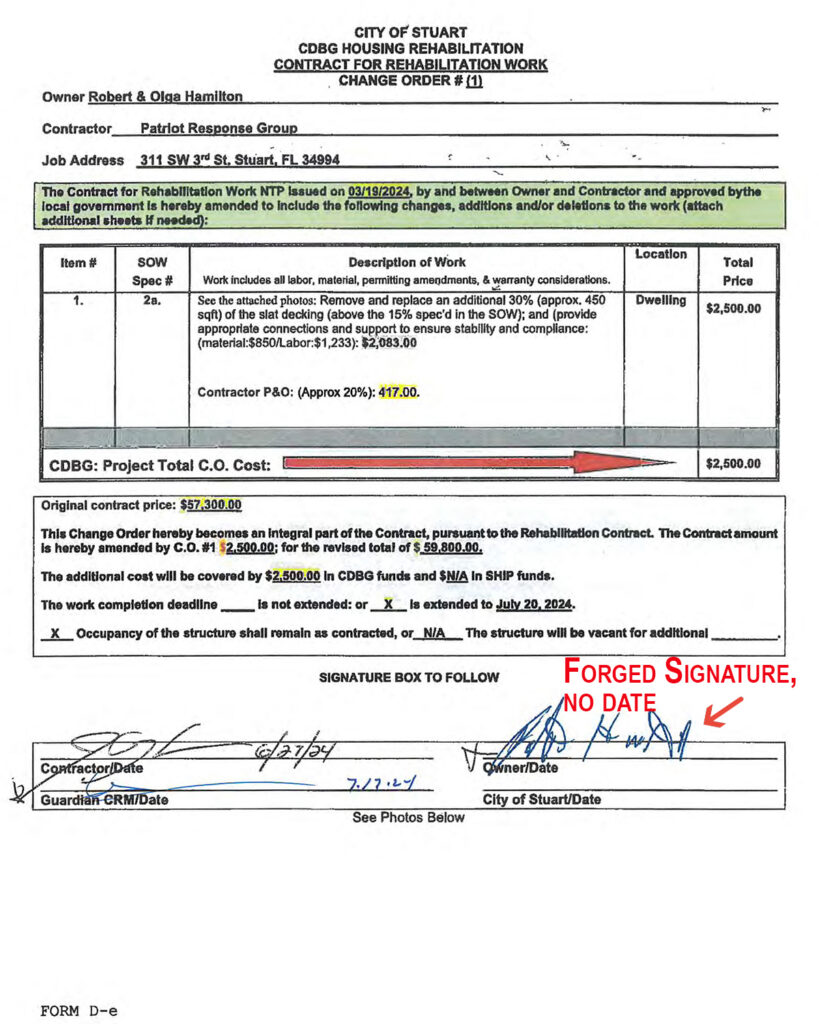
The Change Order with the homeowner’s forged signature.
On December 12, 2024, at 1:03 p.m. EST, CRA Director Gandhi-Savdas provided us with Change Order No. 1 — a document we had originally requested on July 24, 2024, along with other financial records for our project.
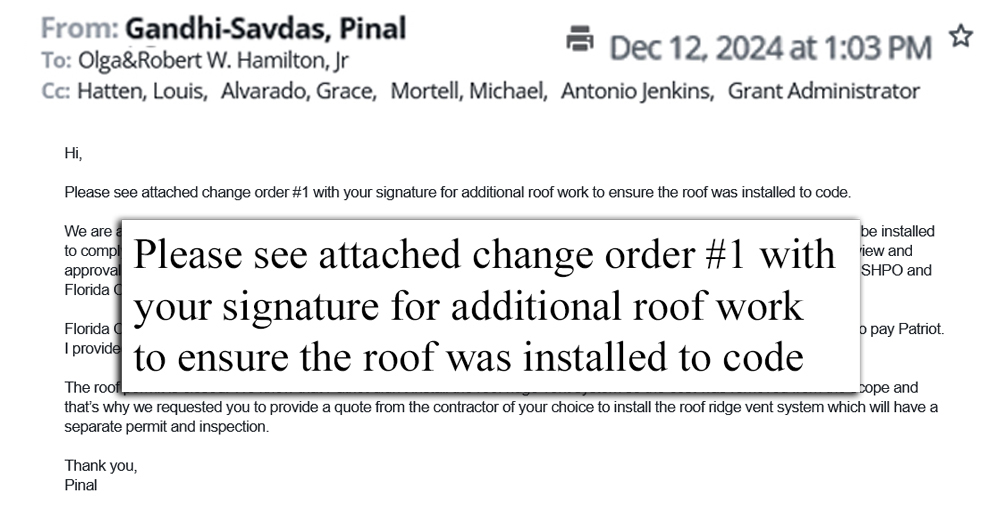
Neither of us signed this particular document under federally funded Small Cities CDBG program.
The Subgrant Agreement between FloridaCommerce (formerly DEO) and the City, specifically Attachment E – Category Specific Conditions for Housing Rehabilitation, states:
Change orders for housing rehabilitation or reconstruction shall be approved by the housing unit owner (or his or her representative), the contractor, and a representative of the Recipient prior to initiation of the work based on that change order.
The second deck replacement work was performed on June 21, 2024. Change Order #1 was signed by the contractor on June 27, 2024, and by Guardian CRM, Inc. on July 17, 2024. There is no date next to the homeowner’s forged signature, and the “City” signature is missing. The photographs attached to Change Order #1 also show a falsified date of June 24, 2024 — a day on which no work was performed on our property.
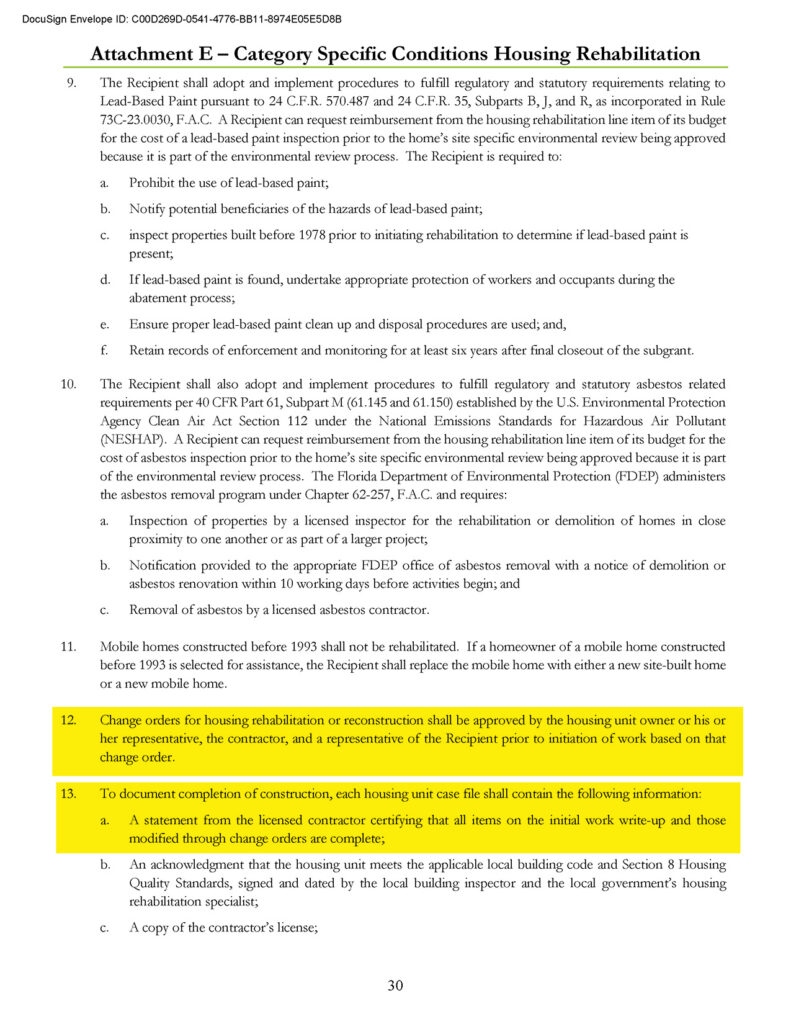
Attachment E – Category Specific Conditions for Housing Rehabilitation also states:
“Rehabilitation of all housing units funded in part or in full with CDBG funds must be in compliance with the current Florida Building Code – Existing Buildings, as well as local building codes and local maintenance codes. If housing units must be replaced, construction of new units must be in full compliance with the current Florida Building Code.”
It further requires that, to document completion of construction, each housing unit case file shall contain the following information:
a. A statement from the licensed contractor certifying that all items on the initial work write-up and those modified through change orders are complete;
b. An acknowledgment that the housing unit meets the applicable local building code and Section 8 Housing Quality Standards, signed and dated by the local building inspector and the local government’s housing rehabilitation specialist.
We were not provided with an acknowledgment that our “housing unit” meets the applicable local building code, signed and dated by the local building inspector and the local government’s housing rehabilitation specialist, before the City disbursed taxpayer funds to the contractor. The only statement certifying that all items on the initial work write-up and those modified through change orders were complete — the “new order for contract closeout” which also includes the charges in Change Order #1 with Mr. Hamilton. Jr. forged signature — was provided to us without our signatures or consent.
“A Cherry on Top” – The Hurricane Ties Installation by Patriot Response Group
After reviewing the roof permit file, we discovered that the contractor did not submit any proper documentation regarding the hurricane ties installation to the City of Stuart Building Department. On May 22, 2024, the contractor installed the wrong hurricane ties and installed them incorrectly — as confirmed by the hurricane ties manufacturer in response to an inquiry by a wind mitigation inspector.
On June 14, 2024, and again on June 19, 2024, we informed Mr. Jenkins of Guardian CRM that the hurricane ties had been installed incorrectly. Mr. Jenkins ignored our concerns.

To our knowledge, the City of Stuart did not cite the contractor for the unauthorized installation of the wrong hurricane ties. On January 16, 2026, City Attorney Baggett wrote: “The structural components of the roof were never in the original scope of work. In addition, the work that Patriot performed on the structural components of the roof was never approved in a change order and never approved by the Project Manager. Furthermore, the Building Department never inspected the ‘hurricane ties and overstressed rafters’ because those components were not part of the permit, nor part of the scope of work.”
In the first place, if the hurricane ties installation was truly outside the scope of work, why was it performed at all? The installation (or alteration) of hurricane ties on May 22, 2024, was structural work. Once the contractor performed the work, it had to comply with code and permitting rules. Doing it improperly and without proper oversight is a clear violation.
The City, represented by the City Attorney, once again completely ignored the fact that Patriot Response Group installed the wrong hurricane ties in violation of the Florida Building Code and Florida Statute § 553.79.
Below are a few pictures of the hurricane ties installation by Patriot Response Group.


The contractor did not even bother to clean the construction site. Our attic is full of sawdust, broken boards, and other construction debris lying on top of our historic beadboard ceiling and sifting down into the living space.


The prepared by the City of Stuart CDBG management contract between us and Patriot Response Group states: 6.11 The Contractor shall correct any work that fails to conform to the Contract Documents where such failure to conform appears during the progress of the work, and shall remedy any defects at Contractor’s expense due to faulty materials, equipment, or workmanship
The City of Stuart appeared to care less.
On August 24, 2022, the wind mitigation and home inspector gave our then 17-year-old shingle roof an additional “5 years of remaining useful life.” He also noted a mean uplift resistance of at least 182 psf.
As of today, under a federally funded Small Cities CDBG program, the roof has remained incomplete since May 22, 2024, we are left with a shoddy roof replacement — metal attached directly to damaged boards and rafters — along with altered and falsified records, a host of other problems— not just roof but the destructive installation of the replacement windows, a $57,300 Subordinate CDBG Mortgage to the City of Stuart, and serious uncertainty about the safety and longevity of our historic home after what we would call a “fake rehabilitation,” while the City paid the contractor even for work that was never performed.
It looks like some messy “wrong ties” have been installed in the City of Stuart, speaking metaphorically.
To U.S. taxpayers—and especially to homeowners considering participation in programs such as the Small Cities CDBG Housing Rehabilitation Program, Rebuild Florida, or SHIP—please remember this: Grant management firms hired by the government to assist with grant programs, along with their vetted contractors, are paid with federal taxpayer funds. Their priority is to maintain that source of income (in some cases, by all means necessary). Likewise, state and local governments often rely on successful program performance metrics when seeking future grant funding. As a result, there may, in some cases, be strong institutional incentives to portray projects as successful, completed, and compliant with program requirements—by all means necessary.
And the question remains the same for the HUD Office of Inspector General: What constitutes institutional cover-ups in a HUD-funded program?
– Is it the alteration of records and documents?
– Is it forged signatures on project documents?
– Is it denying participants access to financial records related to their own federally funded project?
– Is it threatening participants with liens against their homes if they refuse to sign disputed releases authorizing the payment of taxpayer funds?
– Or is it a pattern of these actions that prevents transparency, accountability, and any meaningful oversight?
Read on: In violation of the Florida Building Code requirements for the existing windows, the City of Stuart CDBG contractor Patriot Response Group altered our historic building’s exterior load-bearing walls, destroyed the windows’ rough openings, and even removed structural components to accommodate the oversized replacement windows that the contractor had negligently ordered for our project.
Click below to read more.
Fraud Risk Management – An Overview. Presentation by the HUD Office of Inspector General

In the Community Development Block Grant (CDBG) and CDBG-Disaster Recovery (CDBG-DR) programs administered by the Department of Housing and Urban Development (HUD), Fraud, Waste, and Abuse (FWA) take on very distinct forms. Because block grants flow through local governments and utilize local private contractors, they face hyper-localized vulnerabilities.
CDBG is a block grant with decentralized administration (states and localities manage projects). Oversight bodies (HUD OIG and GAO Reports on CDBG Issues) have repeatedly identified weak monitoring, inadequate documentation, and contractor/subrecipient compliance problems that lead to improper payments.
Since its inception in 1974, the Community Development Block Grant (CDBG) program has allocated over $160 billion in total formula grants. For standard annual allocations, Congress routinely funds the core program at approximately $3.3 billion to $3.4 billion per fiscal year. When factoring in large-scale disaster recovery supplemental spending (CDBG-DR), Congress has deployed an additional $109+ billion.
1. The Small Cities (Non-Entitlement) Allocation: 30%
By statutory law, HUD splits annual CDBG formula funds into a 70/30 baseline: [1, 2, 3]
- 70% goes directly to “Entitlement Communities” (metropolitan areas with populations over 50,000 and large counties).
- 30% is allocated to state governments. States use this pool to run the Small Cities CDBG program (also known as the Non-Entitlement program), distributing funds competitively to smaller towns, rural areas, and minor municipalities that do not qualify for direct HUD grants. Out of a standard $3.4 billion annual budget, this accounts for roughly $1 billion annually. [1, 2, 3, 4]
2. Percentage Spent on Housing Rehabilitation: ~13% to 28%
The block grant model allows states and local small cities substantial local flexibility, meaning there is no federally mandated fixed percentage that must go to housing rehabilitation. Instead, funding is distributed based on localized project applications. However, federal data tracks historical spending trends: [1]
Rehabilitation Support: An additional 4.4% is dedicated to rehabilitation administration, alongside 2.7% for multi-unit housing rehabilitation. [1]
The Broad Housing Track: Nationally, states and small cities historically allocate between 24% and 27.6% of their total block grant dollars toward any form of housing program. [1]
Direct Single-Unit Rehabilitation: Of that overall block grant pool, approximately 12.9% is explicitly spent on single-unit housing rehabilitation (the single largest direct housing expenditure in the CDBG framework). [1, 2]