
To Florida Department of State, Florida Department of Financial Services, Florida Department of Business and Professional Regulation, U.S. Department of Housing and Urban Development Office of Inspector General, US Government Accountability Office U.S., U.S. Department of Justice, the United States Attorney’s Office for the Southern District of Florida (USAO-SDFL), Florida City & County Management Association, U.S. Taxpayers.
An Open Letter to Florida State and Federal Officials from Olga Hamilton and Robert W. Hamilton Jr., Participants in the HUD-Funded Small Cities Community Development Block Grant Program
FDEO HUD Small Cities CDBG / Florida Department Of Commerce Contract ID: 22DB-OP-10-53-02-H01 / Housing Rehabilitation Project: 311 SW 3rd Street, Stuart, Martin County, 34994 FL
On September 12, 2024, at 4:18 PM, the Office of Citizen Services within the Executive Office of the Governor of Florida responded to our complaint (verbatim excerpt):
Thank you for contacting Governor Ron DeSantis. We are sorry to hear of your difficulties and appreciate the opportunity to respond to your email. Your best source of assistance is your city council members and county commissioners. Individuals dissatisfied with the performance of local officials can always make their views known directly to those officials. We encourage you to work with your city commissioner to reach a resolution regarding your concern. -
Martha Lynn, Office of Citizen Services Executive, Office of the Governor
As participants in a federally funded program administered by the state, we recognize that it is not the direct responsibility of Office of Citizen Services staff to oversee these specialized grant programs, nor is it their role to investigate the performance of local officials.
Following the communication with the Office of Citizen Services, we, unfortunately, learned on September 5, 2024, that accountability does not work this way in the City of Stuart, Florida.
In a September 5, 2024 email at 8:13 AM, City Manager Mortell wrote to the City Commissioners:
The City of Stuart does not serve as the contractor or supervisor of the program. Most importantly, the City Commission does not have the legal authority to vote and decide the outcome.
Michael Mortell, City of Stuart Manager
While the City Commission relies on the City Manager, Commissioner Laura Giobbi stated during the special commission meeting on September 9, 2026, that Mr. Mortell has not always been truthful.
When, under federally funded programs, the very participants whose homes and federal assistance are at issue are denied access to their own project records—or are later provided records that appear altered, incomplete, or even falsified—what realistic chance does the general public have of discovering the truth? If homeowners cannot independently trace the work performed, inspections conducted, documents executed, payments authorized, and federal funds expended on their own properties, meaningful public oversight becomes nearly impossible. Transparency cannot exist when the agencies and program administrators controlling the funds also control the records by which their own performance is evaluated.
An additional and deeply troubling concern involves the City’s handling of our personal and financial information as participants in a federally funded housing rehabilitation program.
At the September 22, 2025 City CRA meeting, journalist and reporter Robin Cartwright publicly stated that the City Attorney and City Manager had shared our personal financial information with her even though she had not solicited or requested it.
If accurate, this disclosure raises serious questions regarding the City’s collection, use, safeguarding, and dissemination of information obtained through its administration of a federally funded program.
What personal or financial information concerning the Hamiltons was disclosed, by whom, for what governmental purpose, and under what legal authority? To whom else has this information been disseminated?
And, critically, have City officials similarly disclosed the private information of other CDBG applicants or participants to journalists, private individuals, political actors, or other third parties? The unsolicited dissemination of program participants’ personal financial information by officials acting under color of their public positions warrants an examination of the City’s records, communications, disclosure practices, and applicable privacy safeguards.
And, critically, have City officials similarly disclosed the private information of other CDBG applicants or participants to journalists, private individuals, political actors, or other third parties? The unsolicited dissemination of program participants’ personal financial information by officials acting under color of their public positions warrants an examination of the City’s records, communications, disclosure practices, and applicable privacy safeguards.
During the August 24, 2026 City Commission meeting, Commissioner Merritt Matheson stated, “We need to leverage connections with higher elected officials, with the County, with businesses, and beyond, with state and federal agencies. And former City Manager Michael Mortell has that experience.”
In light of our experience with the City’s federally funded CDBG program under Mr. Mortell’s leadership, that statement raises an unavoidable question: How far do those “leveraged connections” extend, and at what point can relationships with higher levels of government become an obstacle rather than an aid to independent oversight and accountability?
For more than two years, we have raised documented concerns involving defective and incomplete federally funded construction, disputed payments, denial of financial records, a lien containing falsified dates, a forged homeowner signature, altered or removed permit records, and public statements denying City oversight responsibilities that appear directly contradicted by the State CDBG Subgrant Agreement.
Yet meaningful accountability has remained elusive. Connections with county, state, and federal officials should strengthen governmental accountability—not create additional layers through which serious complaints can be redirected, delayed, minimized, or insulated from independent scrutiny.
When the same City Manager under whose leadership these unresolved issues occurred is publicly praised specifically for his experience in leveraging such connections, taxpayers and program participants have a legitimate reason to ask: How independent can oversight remain when the officials who should provide that oversight are also part of the network of relationships being “leveraged”?
U.S. Department of Housing and Urban Development Office of Inspector General repeatedly highlights that many risks of fraud, waste, and abuse in CDBG-DR programs—including housing rehabilitation and reconstruction—occur in the decentralized delivery chain rather than at the federal HUD headquarters level.
The decentralized structure creates vulnerabilities: funds flow from HUD → state → non-entitlement counties and smaller local governments that do not qualify for direct funding from the federal government → contractors/subcontractors, etc. This multi-layered process creates opportunities for problems, including improper payments, at each step.
Some of the common problem areas identified across audits and investigations include:
- Grantee (State) / subrecipient (City) issues: Inadequate monitoring of programs, weak internal controls, improper payments, falsified invoices, or misappropriation.
- Contractor fraud: False claims for incomplete or shoddy work, bid rigging, collusion, fraudulent billing, or change-order abuse—especially relevant to housing rehabilitation/reconstruction.
- Public corruption: Involving local officials, grant-management consultants, and contractors.
A January 2026 HUD OIG Audit Report, Report Number 2026-FW-0002, on potential fraud risks and schemes involving disaster recovery funds explicitly notes that fraud primarily occurs at the grantee (state) or subrecipient (local government) level. One of the examples provided in the report is an employee encouraging an applicant to falsify information…
On July 19, 2024, we filed our complaint with the City of Stuart CDBG Program Management about the damages inflicted to our historic home by the contractor. The complaint was submitted to Ms. Gandhi-Savdas, the CRA Executive Director and City of Stuart CDBG Project Manager, who has the authority to act on the City’s behalf regarding all aspects of the Project. It was also filed with Guardian Community Resource Management, Inc., a firm contracted by the City to assist with the grant.

On July 24, 2024, we requested the financial records for our project, including a copy of CDBG Change Order #1.
On August 14, 2024, at 9:49 AM, we emailed City Manager Michael Mortell, Building Official Lou Hatten, CBO, BCA, and CRA Director Pinal Gandhi-Savdas requesting reinspections, reopening of the roof permit, and completion and correction of the CDBG work; we also submitted the request through the City’s portal.
Less than six hours later, at 3:41 PM, the City’s OpenGov activity log records Building Department employee Bruce Duncan removing two attachments from Building Permit BP-24-653: “Manufactured Roof Truss drawing” and “Letter of Authorization for Agent, if using an agent.” At 3:42 PM, the same log records him removing two additional attachments: “Revision” and “Florida Approved Products List.” We did not know these documents existed and did not learn of their removal until FloridaCommerce provided the permit activity records to us as an attachment to its April 5, 2025, 11:10 AM EDT email.
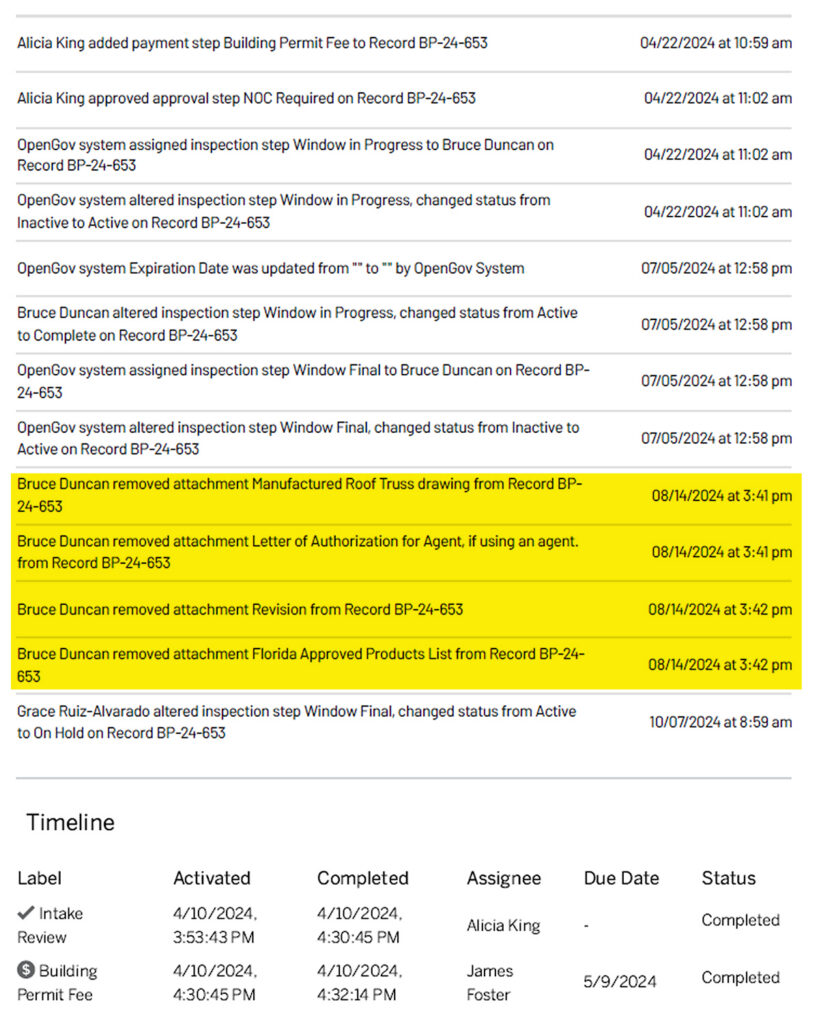
The entries raise questions that have never been adequately answered. What was the “Letter of Authorization for Agent,” who purportedly authorized whom to act for the property owners, and where is the original document? Under our CDBG project documents, the contractor was responsible for obtaining the required permits and applications, yet we never signed a Letter of Authorization for Agent.
If such a document was submitted in our names or represented as homeowner authorization, we want to know who created it, who signed it, when it was submitted, what authority it purported to confer, and why it was removed from the permit record immediately after we requested reinspections.
Likewise, why was a “Manufactured Roof Truss drawing” submitted for our property, what did it depict, and why was it removed? That question became even more significant after the contractor had been paid, when City Manager Mortell stated publicly at the November 25, 2024 City Commission meeting that our home had damaged trusses while defending the contractor’s installation of wrong hurricane ties.

If damaged trusses had actually been identified during the CDBG roof work, when were they discovered, who documented them, why were we, the homeowners, never notified, and how did the Building Department approve and close the roof permit despite the structural damage?
What was the “Revision” removed at 3:42 PM, what was being revised, who submitted it, and where is the preserved original?
These are not insignificant administrative questions. They concern records generated and maintained in connection with construction performed under a federally funded CDBG Housing Rehabilitation Program. The activity log does not merely show that documents are presently absent; it affirmatively records their removal, identifies the City employee associated with those actions, and timestamps those removals less than six hours after the homeowners requested that the City reopen and reinspect the work. Most importantly: by whose authority and for what purpose these federally related project records were deleted?
The next day, on August 15, 2024, at 1:58 PM EDT, Guardian CRM sent an email to us and City Manager Michael Mortell. In the email, Guardian CRM denied our request for a fully itemized final bill with supporting documentation—including a copy of Change Order #1—and simultaneously threatened us with liens. Verbatim excerpts:
The only action being taken at this time is the official dissolution of the agreement between you (The Hamilton’s) and the contractor (Patriot Response Group). This will allow: (1) avoidance of any mechanical liens that the contractor will have a legal right to impose should just due payment not be rendered…” “Itemized invoice from Patriot Response Group: such an invoice will not be generated from the contractor until a dissolution agreement is agreed upon by the applicable parties, signed, and approved. Because the roof has passed the final building department inspection, should you wish to have it reevaluated by a building inspector, that is a request you will need to make through the Building Department. Once and item has passed a final inspection, any “appeals” protocol is separate and apart from the Program.
Antonio Jenkins, Guardian Community Resource Management, Inc
On August 22, 2024, at 2:07 PM, following our inspection of the roof permit files, we notified the City of several violations by the CDBG contractor. Specifically, the contractor failed to file the CDBG Scope of Work with the Building Department for our project. Additionally, they installed incorrect hurricane ties without Building Department approval or the submission of installation specifications. Finally, the contractor failed to install the roof ridge vent system required by the CDBG Scope of Work; instead, they removed our functioning ridge vent, completely sealed and capped the roof ridge, leaving our home entirely without proper ventilation. However, the contractor placed roof ridge vent mesh from inside the attic to create the deceptive appearance that a proper roof ridge vent had been installed.

On September 3, 2024, 12:26 PM, CRA Director Gandhi-Savdas wrote to us (verbatim excerpts) :
You requested the balance for the CDBG. The CDBG program policy does not allow a rehab project budget to exceed $80,000.00. The payment due to Patriot is $48,490 (see breakdown below). Your project has $31,510.00 that can be utilized to finalize the new window installation and finish. In order to ensure homeowner protection against mechanical liens, it is recommended that the contractor be paid for completed work.
CRA Director Pinal Gandhi-Savdas
At this point, it became clear that the City planned to use the remaining CDBG funds, which are legally restricted to eligible program activities, to hire another contractor to remediate substandard, destructive, and potentially fraudulent work. Furthermore, instead of investigating the contractor’s violations, the City attempted to coerce the release of payment by threatening us with liens.
On September 5, 2024, at 8:13 AM, City Manager Mortell wrote to us and the City Commission (verbatim excerpts):
Essentially, the City of Stuart does not serve as the contractor or supervisor of the program. ...the City does not select the program administrators or the contractors... the City has already done the inspections... we can not just go back and change the inspections. It is very complicated. It seems to me that you would benefit from signing the document to all them to take the actions to replace your windows but I am not telling you what to do either.
Michael Mortell, City Manager
Given his background as a member of The Florida Bar – a government attorney, City Manager Mortell pressured us to sign the ‘CHANGE ORDER PREFACE AND TERMS OF DISSOLUTION’ document explicitly stating:
All parties acknowledge heretofore, and upon receipt of this dissolution notification, that the consideration provided and received by all is fair, just and reasonable and that no further consideration, compensation or obligation will be due, payable or owing with regard to the Contract and/or termination of the contract.
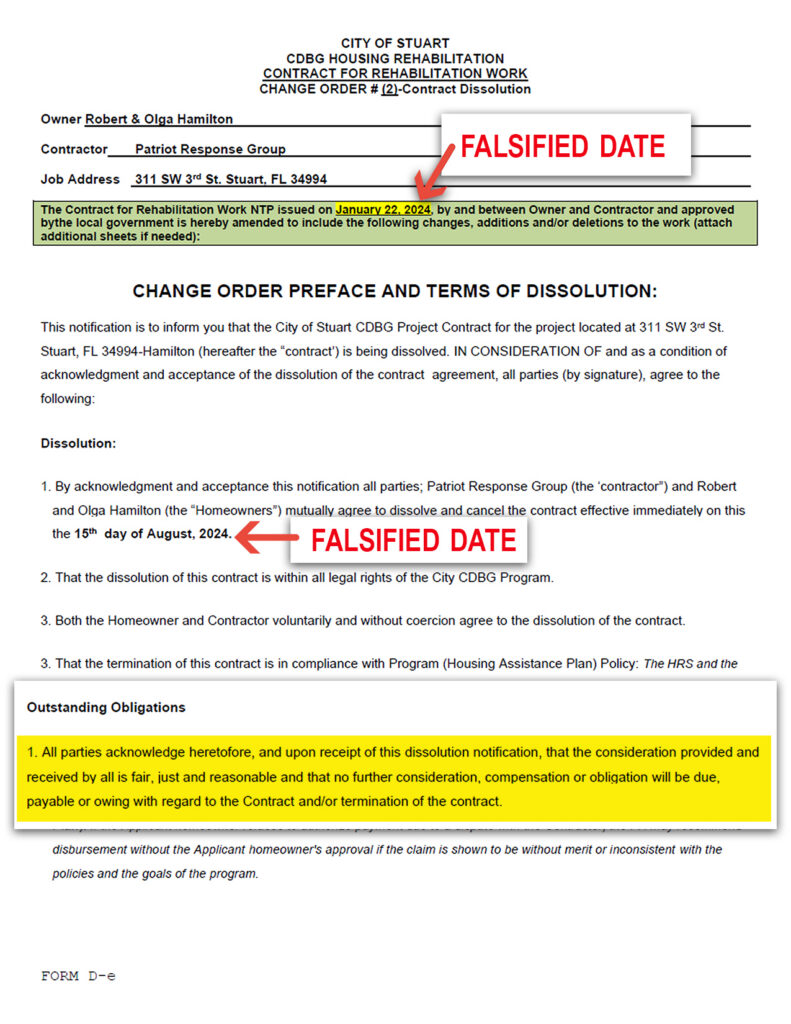
Furthermore, the dissolution document was dated to August 15, 2024, even though the contractor had not performed any work since July 13, 2024. The contractor had already removed their trailer from our property on July 26, 2024. That same day, after Guardian CRM notified us that the contractor was removed from the project, we responded via email stating:
No one from their company or their proxies are allowed on our property anymore. We feel intimidated and unsafe. On June 20, 2024, we already expressed our concern and mentioned through the phone messages that "we are very scared of these people." We want then permit left open.
Olga Hamilton
Following the City Manager’s September 5, 2024 email, on September 9, 2024, at 1:04 PM, in an email to us that also included then-City Manager Michael Mortell, City Commissioners, and City Building Department staff, CRA Director Pinal Gandhi-Savdas again proposed using the remaining balance of our CDBG project funds to install new replacement windows to replace the failed, oversized replacement windows, expressly stating that the new work would include “framing as needed.” She wrote that the work would be completed “utilizing project budget” and stated that $33,510 remained available for the new window installation.

City CRA director and CDBG Project Manager Gandhi-Savdas acknowledged in her October 7, 2024 email that the roof ridge vent system wasn’t installed but flatly denied to reopen the permit to complete the work. Instead, her plan was to release the funds to Patriot Response Group for unperformed work, and to hire another contractor and pay a second time for the exact same installation.

Why were the remaining CDBG funds allocated to our project expected to be used a second time to correct and replace the same window work that had already been included in the original 2023 CDBG Scope of Work and contract price? And what funds were expected to pay for installation of the roof ridge-vent system, which was already required by the same 2023 CDBG Scope of Work and included in the original rehabilitation project?
Even under the threat of liens, we refused to sign documents declaring that the payment to Patriot Response Group was ‘just, fair, and reasonable’—especially after being denied access to the financial records for our project.
Anyway!
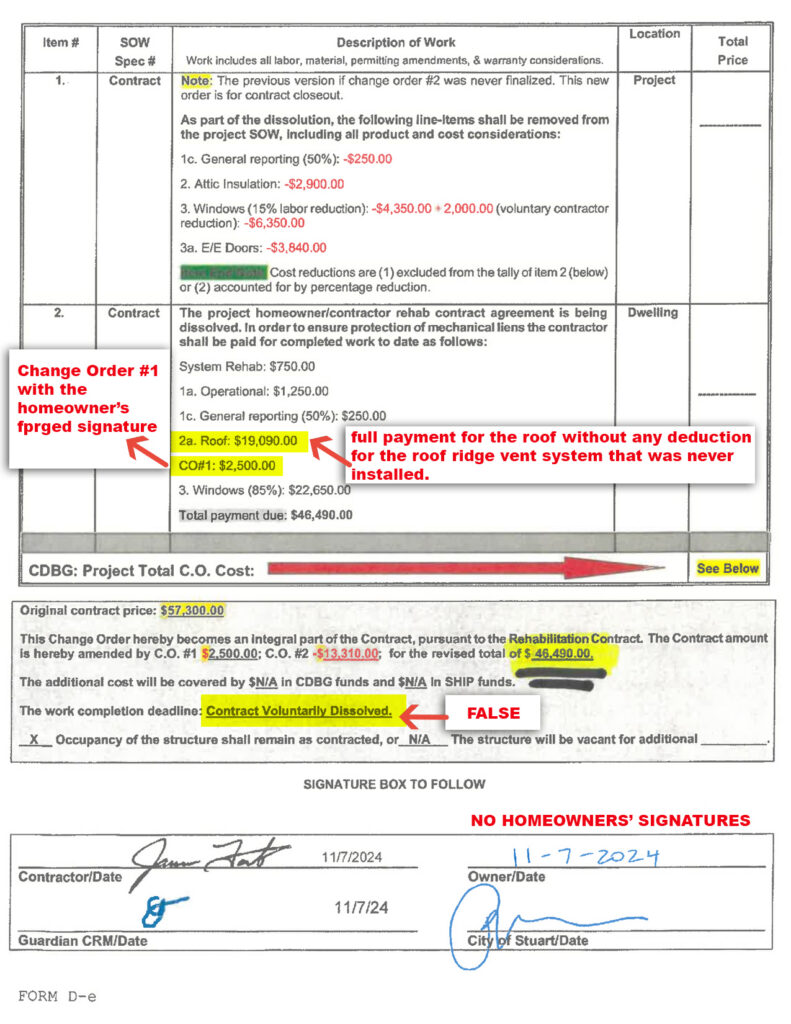
On November 7, 2024, the City CRA Director, Guardian CRM, and the contractor, Patriot Response Group, signed a document falsely claiming that the contract was ‘voluntarily dissolved.’ We dispute that characterization because we did not agree to a voluntary dissolution and never signed the document.
- Who selected the effective date?
- What specific records support that date?
- Was this document knowingly used to misrepresent our consent or illegally justify payment?
The City released taxpayer funds before the State Historic Preservation Office had even completed its evaluation on November 22, 2024. (The engineer report below contains the State Historic Preservation letters and correspondence)
This action was taken entirely without our signatures. Furthermore, it was executed without any investigation into a fraudulent lien containing falsified dates, or the fraudulent claim of a roof ridge vent installation. They proceeded despite knowing that the contractor failed to file the CDBG Scope of Work with the Building Department, and despite the contractor filing a falsely notarized Notice of Commencement with the Martin County Clerk of Court.
Finally, they did this while actively denying our requests for re-inspections and project financial records.
In November 2024, the City of Stuart released CDBG funds for work that a structural engineer later deemed in his report to be ‘poor workmanship bordering on amateurish installation.’
On May 13, 2025, the structural engineer hired and paid by the City stated in his report the same violations as we wrote in our complaint to the City on July 19th, 2024.
Funds were even released for work that was never performed, specifically the ‘fake’ roof ridge vent system.
Powered By EmbedPress
In an email dated October 18, 2024, FloridaCommerce stated to the City that the work performed on our historic home did not appear to be compliant with the Site-Specific Environmental Review Condition. Consequently, they noted that the costs might not be eligible for reimbursement with federal funds.

Despite FloridaCommerce’s direction that City funding be used to pay Patriot Response Group and remove the lien, City records show that the $46,490 payment was processed through Fund 105—the City’s CDBG Fund.

Later, we were provided with documents containing falsified dates. This included a CDBG Change Order bearing my husband’s forged signature. Although we originally requested this document on July 24, 2024, the City CRA Director did not provide it to us until December 12, 2024—a full month after she had already released the payment to the contractor in November 2024.


The execution timeline of Change Order #1 represents a material breach of Attachment E, Section 12 (Page 31) of the DEO Subgrant Agreement, which strictly mandates:
12. Change orders for housing rehabilitation or reconstruction shall be approved by the housing unit owner or his or her representative, the contractor, and a representative of the Recipient prior to initiation of work based on that change order.
DEPARTMENT OF COMMERCE Agency Contract ID: 22DB-OP-10-53-02-H01
While the contractor signed and dated the document on June 27, 2024, and the city’s consultant, Guardian CRM, signed it on July 17, 2024, the attached progress log photographs claim to document project milestones on June 21, 2024, and June 24, 2024. There was no actual work performed by the contractor on June 24, 2024! Furthermore, there is no date entered next to the homeowner’s forged signature.
In an email dated January 16, 2026, at 4:56 PM, City Attorney Baggett asserted that the CRA Director had no reason to doubt the authenticity of the signature. However, this assertion fails to explain why the CDBG project management withheld CDBG Change Order #1 and denied our requests to view it before releasing taxpayer funds.
As the designated CDBG Project Manager, the CRA Director possesses explicit authority to act on all aspects of the project. Under the Code of Federal Regulations governing CDBG administration, the City bears the ultimate responsibility for direct oversight, compliance, and meticulous record-keeping. The City cannot claim ignorance while actively withholding the exact records it is legally mandated to maintain.
City Attorney Baggett also stated in his January 16, 2026 email (verbatim excerpt):
The specifications of the ridge vent system was not part of the permit process before the Building Department. Since the ridge vent system is in the revised Scope of Work, it will be part of the permit process in the future.
Lee Baggett, City Attorney
When City Attorney Baggett wrote this, he could not have been ignorant of the fact that we had already notified the City in August 2024 that the contractor, Patriot Response Group, had failed to file the 2023 CDBG Scope of Work—which mandated the installation of the roof ridge vent system—with the Building Department. City Attorney Baggett was present at the City Commission and CRA meetings when we spoke. To date, the City has failed to rectify this issue, and the 2023 CDBG Scope of Work remains missing from the permit records.
City Attorney Baggett also stated in his January 16, 2026 email that the hurricane ties were excluded from both the Scope of Work and the re-roof permit and that the Building Department therefore had no reason to inspect them. However, Patriot Response Group installed hurricane ties and altered structural components of our historic home’s exterior load-bearing walls without providing us with approved structural plans or documentation establishing that the alterations were authorized and properly inspected.
Dear Florida Department of Business and Professional Regulation, we had notified the City of these concerns on August 22, 2024. Does the installation and structural alterations require a permit, permit revision, engineering approval, or inspection under the Florida Building Code and Florida Statutes § 553.79(1)(a)? Dose contractor’s conduct constitute grounds for disciplinary action under § 489.129? Was there any examination of the Building Department’s permit records, inspection reports, approved plans, and internal communications to establish what work was authorized, what was actually inspected, who approved it, and why our documented complaints did not result in a recorded investigation or corrective action?
Powered By EmbedPress
CDBG funds are strictly tied to specific federal regulations—such as environmental reviews, historic preservation, etc. Consequently, work should not have even begun on our project without an approved permit validated by the CDBG Scope of Work (SOW).

Furthermore, City CRA Director and CDBG Project Manager Gandhi-Savdas falsely stated in her December 12, 2024 email that the cost of the roof ridge vent system had been removed from the final invoice. In reality, the cost was never removed. This omission occurred despite the fact that we had provided the City CRA Director, City Manager Mortell, and the City Commission with a third-party bid to install the roof ridge vent system, which was attached to our email dated September 22, 2024, at 7:09 PM. Instead of adjusting the balance, the City paid the full original amount for the roof, plus an additional $2,500.00 for CDBG Change Order #1, which bore my husband’s forged signature.
On September 18, 2025, at 1:05 PM, City Manager Mortell wrote to the City Commissioners stating (verbatim excerpt), “SHPO has approved the roof – with the cobra vent.”
This statement raises critical compliance questions regarding how the State Historic Preservation Office (SHPO) could have legitimately approved a non-existent “cobra vent” installation—particularly on a standing seam metal roof. Furthermore, because no personnel from SHPO ever performed an on-site physical inspection of the roof, the agency was forced to rely entirely on information submitted by local officials and/or Guardian CRM. This leaves a troubling question: Who provided SHPO with this false information?
Following an inspection on October 1, 2025, Islander Home and Property Inspections, LLC confirmed in its official report that no functioning roof ridge vent system had been installed.
But on September 22, 2025, both City Manager Mortell and Mr. Jenkins of Guardian Community CRM stood before the CRA Board and City Commissioners and provided false information.
On September 18, 2025, at 2:27:02 PM, City Manager Mortell wrote to Commissioner Reed and the City Attorney regarding our project, stating verbatim: ‘The doors are complete.’ This statement is entirely false. We do not have ‘three completed doors’ on our project.
When a city alters permit activity logs, processes documents containing falsified dates, relies upon a Change Order bearing an allegedly forged homeowner signature, and authorizes payment for work that records and physical evidence indicate was not performed, what is that if not evidence warranting investigation for false certification, false claims, procurement fraud, and misuse of federal funds?
These facts raise significant questions regarding the oversight of public funds, particularly because the City’s CDBG-CV grant program expanded from $4.7 million to over $10 million. When an agency manages millions of dollars in taxpayer money, any failure in compliance, oversight, or record-keeping becomes a matter of direct public interest and a legitimate concern for taxpayers.
In her December 12, 2024 email, City CRA Director Gandhi-Savdas stated that FloridaCommerce had directed the City to pay using CDBG matching funds.
However, her statement directly contradicted a November 26, 2024 email from FloridaCommerce to us, which explicitly stated that the agency did not consider the payment made to Patriot Response Group to be an eligible use of CDBG funds at that time.
To date, we have not received any other official letters or statements from FloridaCommerce indicating otherwise, or explaining when and why they would have directed the City to use CDBG matching (leveraging) funds.
Furthermore, CRA Director Gandhi-Savdas failed to provide us with any document from FloridaCommerce regarding the release of the CDBG matching funds.

FloridaCommerce’s own rules explicitly state that leveraging or matching funds must be spent only on eligible activities for the specific grant program being funded.
The Subgrant Agreement between FloridaCommerce and the City (Attachment A – Project Narrative, Page 17) notes that the City committed $50,000.00 in local CRA leverage funds. It explicitly dictates: ‘The CRA TIF funding will be expended after the CDBG site visit and before administrative closeout of the CDBG grant. – Agency Contract ID: 22DB-OP-10-53-02-H01
We have no documentation from FloridaCommerce qualifying a destructive replacement window installation and a non-existent roof ridge vent installation as eligible activities.

Our concern is that HUD does not require grantees to report to them or track their use of matching funds.
Stephen M. Begg, HUD OIG — “Decades of Dysfunction: Restoring Accountability at HUD,” April 8, 2025, before the House Financial Services Subcommittee on Oversight and Investigations.
Financial/Performance Reporting Fraud Schemes identified by HUD OIG also include Performance Reporting Fraud—the deliberate misrepresentation of the progress or impact of a project with the intent to deceive and continue receiving federal funds.
On November 26, 2024, FloridaCommerce also wrote to us that the City maintained that the work on our project had been done correctly and in accordance with all requirements. The 2023 CDBG Scope of Work for our project included the replacement of twenty windows. However, the contractor, Patriot Response Group, replaced only seventeen of those twenty windows. The City, Guardian CRM, and the contractor Patriot Response Group certified the replacement-window portion of the project as 85% complete—the exact percentage represented by seventeen of the twenty contracted windows.
We filed a formal report regarding the forged signature with the Stuart Police Department in December 2024. However, this creates a clear conflict of interest, as one city department is investigating another department under the exact same city management—where all municipal departments ultimately operate under Mr. Mortell’s direct control.
Unsurprisingly, we still do not know who forged my husband’s signature on CDBG Change Order #1. We remain in the dark regarding how the CRA Director obtained the document, from whom she received it, or whether it was entirely created or altered inside her own office.
Furthermore, we are left to wonder how many more altered or falsified records remain hidden in our file.
Only after the City of Stuart released payment to Patriot Response Group for our CDBG rehabilitation project did the City’s CDBG project management provide us with the requested Contractor and Subcontractor Affidavits.
The affidavit submitted by the contractor, Patriot Response Group, lacks the printed name of the individual who signed the document. Compounding this issue, the affidavit was notarized by Vance Olvey—a field supervisor for the company and the brother of its owner, Michael Olvey. This is the same Vance Olvey who originally signed the CDBG contract between us, the homeowners, and Patriot Response Group, as well as multiple other project documents.

This was not the first questionable affidavit notarized by Vance Olvey. Earlier, on August 27, 2024, at 5:04 PM, we sent an email to City Manager Mortell requesting an investigation into another suspect document. This document, titled “Reroof Sheathing Affidavit,” was signed by James Foster and notarized by Vance Olvey. However, James Foster was never personally on our roof, and we have never seen him on our property.
Is it legally permissible under Florida law for a contractor’s immediate family member to notarize that contractor’s own compliance affidavits?
The Merrigan Building Group, LLC, affidavit was dated October 4, 2024. Merrigan’s only work on our property occurred July 5–7, 2024, when it performed the first destructive installation of the oversized replacement windows, work that failed. Merrigan’s affidavit does not identify the value of that work at our property. Instead, it combines seven separate housing rehabilitation properties, including “139 – Hamilton – 311 SW 3rd St,” under a single aggregate final-payment amount of $44,385.56 for “materials and/or services,” without identifying how much was attributable to our property, what portion represented labor or materials for our window installation, or how that amount corresponded to the costs the City ultimately approved and paid to Patriot Response Group for our CDBG project.

The fact that a multi-property, non-itemized subcontractor affidavit was provided to us only after payment—despite our prior requests for the financial records supporting the expenditure—raises serious questions about what property-specific invoices, affidavits, releases, and source documentation the City and its CDBG program management actually reviewed before approving payment, and how they determined that the amount charged to our federally funded project was adequately documented, allowable, and attributable to work actually performed at 311 SW 3rd Street.
To date, the City of Stuart has not provided us with the requested subcontractor affidavit or project-specific financial documentation for Dream Bros. Construction LLC, the subcontractor deployed to our historic homestead from June 10 through June 13, 2024, to attempt to reinstall the already failed, oversized replacement windows.
That intervention resulted in additional deficiencies, including several windows being installed off-center. The absence of these records is particularly concerning because Page 2, Section (5), “Records,” of the DEO Subgrant Agreement expressly requires the City, as Recipient, to “retain sufficient records on-site to show its compliance with the terms of this Agreement, and the compliance of all subrecipients, contractors, subcontractors, and consultants paid from funds under this Agreement, for a period of six years.”
The DEO Subgrant Agreement further provides in Page 4, Paragraph (8)(a), “Monitoring,” that the City “shall monitor its performance… including the performance of any subrecipients, subcontractors and/or consultants,” while Page 8, Paragraph (18)(h) makes the City “ultimately responsible for the administration of this Agreement, including monitoring and oversight of any person or entity retained or hired.”
These contractual responsibilities are reinforced by 2 C.F.R. § 200.318(h), which requires federally funded contracts to be awarded only to responsible contractors possessing the ability to perform successfully, with consideration given to matters including contractor integrity, compliance with public policy, past performance, and financial and technical resources.
The president and manager of Dream Bros. Construction LLC had a documented criminal court history predating the company’s June 2024 CDBG work and was subsequently arrested in September 2024; on June 15, 2026, the Sarasota County Circuit Court adjudicated him guilty of three third-degree felony controlled-substance possession offenses and one first-degree misdemeanor drug-paraphernalia offense in Case No. 2024 CF 008968 NC, Sarasota County.
These circumstances make the continued absence of the Dream Bros. subcontractor affidavit and supporting records especially significant and raise a fundamental question: What contractor/subcontractor-integrity, licensing, qualification, insurance, financial-documentation, and responsibility review did the City and its CDBG program administrator conduct before allowing subcontractor Dream Bros. Construction LLC to perform federally funded rehabilitation work on our historic home, and what records did the City rely upon when approving and paying costs associated with that work?
Were their licensing, qualifications, integrity, past performance, financial and technical capacity, subcontractors, insurance, and compliance with program requirements actually verified and documented consistent with the federal responsibility standards of 2 C.F.R. § 200.318?
On August 15, 2024, shortly after Guardian CRM sent an email pressing for payment to Patriot Response Group and raising the possibility of liens, Isaac Martinez of K1 Roofing called my personal cell phone and told me that he had not been paid for the metal-roof installation work he performed on our property. During that call, Mr. Martinez specifically reminded me that I had taken photographs of him while he was working at our home. He was correct. We preserved both the telephone record documenting his August 15 call and photographs showing Mr. Martinez performing work at our property while wearing his K1 Roofing uniform.

On December 19, 2024, at 5:19 PM, Guardian Community Resource Management wrote to us, FloridaCommerce, CRA Director Pinal Gandhi-Savdas, and then-City Manager Michael Mortell:
“The below list of workers was all part of Merrigan Group, if you wish you may contact them directly to see if they can obtain release of their subsidiaries.”
That response raises more questions than it answers. Merrigan Building Group did not perform the roofing work on our property. The first time Merrigan was introduced to us was on July 1, 2024, in connection with the replacement-window installation. The roof metal installation took place on June 28, 2024. That day, Guardian CRM’s Antonio Jenkins sent us Merrigan’s business card and informed us that Merrigan’s crew would be responsible for the window installation and that the contractor was a general contractor qualified to perform the work. The contemporaneous text message and business card we preserved document that introduction.

More fundamentally, why were we—the homeowners and participants in a federally funded CDBG program—being told by the City’s grant-management firm to contact workers and subcontractors ourselves in an effort to obtain releases and documentation that should have been maintained within the program’s own project, contractor, procurement, and payment records?
The City’s own CDBG Residential Rehabilitation Contract made the subcontractor affidavits a prerequisite to payment. Article 3.3 states unequivocally that, “Prior to the Contractor being entitled to any payment,” Patriot Response Group was required to provide both the homeowners and the CDBG Program with an affidavit identifying every subcontractor or materialman who had performed work through the date of the payment request, together with affidavits from each confirming payment in full and release of all lien rights.
Article 3.4 further authorized withholding payment where liens existed, required inspections had not passed, required documents had not been submitted, defective work remained uncorrected, or contractor performance was unsatisfactory.
Accordingly, the relevant question is not whether subcontractor affidavits could be collected after Patriot was paid. If the required affidavits were not obtained and provided before the payment request was approved, on what contractual and documentary basis was Patriot determined to be entitled to payment?
As U.S. taxpayers, we are told that federally funded programs such as the Small Cities Community Development Block Grant (CDBG) Program exist to benefit low- and moderate-income citizens and preserve and improve safe, affordable housing. But what happens when a local government accepts those federal funds, places a $57,330 Subordinate Mortgage on your home, and then completely abdicates its legal responsibility to protect your safety, your property, and the integrity of the taxpayer funded program?
Applicant-homeowners and their properties are subjected to extensive scrutiny before receiving assistance under federally funded CDBG programs, including verification of income, ownership, occupancy, property eligibility, multiple inspections, and other sources of assistance, while FloridaCommerce-administered programs use formal Duplication of Benefits (DOB) procedures and interagency data-sharing mechanisms, including FEMA information and SBA data, to identify prior assistance and prevent duplicate benefits.
Our eligibility was not in dispute. In fact, on December 12, 2024, 1:28 PM, City Manager Michael Mortell wrote to us:
“There is no dispute that you qualified for a 67,000 dollar grant that was intended to replace your roof and your windows.”
Yet in the same email he instructed City employees:
“By way of this email, I am asking the staff to refrain from responding to each of your emails until such time as we have had a chance to finalize the review with SHPO and there is an actual need for the communication.”
This raises even more troubling questions: Was December 12, 2024, the first time City staff had been instructed not to respond to us, or had similar instructions already been given when our repeated requests for Building Department reinspections and investigation of the defective CDBG work went unanswered?
Was anyone instructed, authorized, or encouraged to alter, remove, or otherwise modify permit activity records or attachments associated with our CDBG project? And what happened to the record of our 2020 residential Change of Use? Our Change of Use/occupancy process occurred in 2020, including permit and inspection payments on March 3, 2020, and Martin County approved our homestead exemption in May 2020. Yet years later, the City’s permit history raised questions about that Change of Use, culminating in City Manager Mortell’s October 27, 2025 public assertion that we had never completed a residential Change of Use and the homeowners subsequently being required to sign another Change of Use application.
Was the original 2020 record deleted, altered, reclassified, or otherwise changed; when did any such change occur; who made or authorized it; and was the later permit record relied upon to support the City Manager’s public accusation?
Our property was not the only CDBG-assisted property affected by a construction lien. A subcontractor filed a lien against another homeowner participating in the same City of Stuart CDBG Housing Rehabilitation Program, Margaret Bromfield, and the records again lead back to the same program parties—Patriot Response Group as the general contractor and Guardian CRM, Antonio Jenkins, in the program-management chain.
Under the Martin County State Housing Initiatives Partnership (SHIP) Program, a subcontractor filed construction liens against three additional properties. The associated public records identify Patriot Response Group as the general contractor and Mr. Jenkins of Guardian Community Resource Management, the program-management firm.
When liens arise on multiple federally and/or state assisted homes involving the same general contractor and program-management structure, the issue can no longer be viewed solely as an isolated dispute between one homeowner and one contractor. It raises broader questions about contractor oversight, subcontractor payment verification, lien protection, and the financial controls being exercised across the publicly funded housing rehabilitation programs.
On August 28, 2025, at 5:29 PM, Lecia Behenna, Deputy Director, Office of Long-Term Resiliency, FloridaCommerce wrote:
The City of Stuart’s contract with FloridaCommerce for Housing Rehabilitation activities expires on January 31st, 2026. It is the Department’s expectation that all parties will work in a collaborative manner to complete all construction activities by the Agreement expiration date.
Lecia Behenna, Deputy Director, Office of Long-Term Resiliency, FloridaCommerce
We are deeply concerned—and U.S. taxpayers should be concerned as well.
What, exactly, does FloridaCommerce mean by its expectation that “all parties” work collaboratively?
By the time FloridaCommerce made that statement, we had already endured an extraordinary series of events after City Manager Mortell signed the payment request authorizing payment to Patriot Response Group from the City’s CDBG Fund 105, while we continued raising concerns about incomplete, defective, and destructive work.
Rather than receiving meaningful answers, we repeatedly had to challenge statements by the City Manager that were not merely misleading, blatantly untruthful, and demonstrably contradicted by the City’s own records and the governing CDBG documents.
The situation escalated to the point that then-City Manager Michael Mortell publicly accused Commissioner Reed on CBS 12 News of conspiring to commit fraud involving the CDBG grant after Commissioner Reed challenged the false information Mortell and Guardian CRM’s Antonio Jenkins were providing about a purported “Cobra” roof vent that did not exist on our roof.
What, then, does “collaboration” require of the homeowners?
Are we expected to submissively sign another set of CDBG documents for additional federal assistance so that a second contractor can repair or replace work for which the original contractor, Patriot Response Group, was already paid, while placing another CDBG Subordinate Mortgage—or increasing the CDBG indebtedness secured against our home—on top of the existing $57,330 CDBG Subordinate Mortgage? Why should we be required to assume additional financial obligations to correct work already covered by the original CDBG contract and payment, without first resolving the disputed expenditures, alleged falsification and alteration of project records, alleged forgery of the homeowner’s signature, and failures of contractor oversight?
When the government charges federal grant funds under separate contracts for the same work, service, or cost, without a legitimate allocation or documented basis, does that constitute impermissible duplicate billing, cost misallocation, or cross-charging—and how would federal or state auditors ever discover it if the underlying records are incomplete, altered, withheld, or inaccurate?
And when City Attorney Baggett subsequently pressed us to execute documents to move the project forward, we were left with an unavoidable question: Would signing those documents create a new administrative and financial paper trail that effectively absorbs the cost of correcting previously paid defective or incomplete work, without first accounting for the original payment?
Is this how an improper or unsupported expenditure can ultimately become buried beneath subsequent change orders, additional funding, new contractor payments, and another mortgage obligation—rather than being identified, investigated, and corrected?
The work started on May 22, 2024, and, as of today, we are left with a $57,330 CDBG Subordinate Mortgage for an incomplete project involving shoddy, destructive, and even fraudulent work, with lead that was not removed despite the February 2023 inspection and report; an attic full of construction debris after the roof decking was replaced twice; holes in our exterior load-bearing walls that you can see through; high humidity and temperatures reaching up to 100°F on hot days and dropping into the 30s and 40s on cold days; damaged trusses; and a metal roof attached to damaged sheathing. The front fascia partially fell off just a few months after it was installed, and the effects of the poor workmanship continue to deteriorate further and faster.
To U.S. Taxpayers and Citizens Considering Applying for CDBG-DR, Small Cities CDBG Housing Rehabilitation/Reconstruction, or Similar Government-Funded Programs:
Fraud, waste, abuse, and improper payments do not occur in a vacuum. The disbursement of federal funds requires approvals and authorizations by government employees responsible for overseeing and monitoring these programs, including project activities, recordkeeping, document review, and payment approvals.
Most participants in these programs are not familiar with the complex federal and state laws, regulations, codes, documentation requirements, and administrative procedures governing federally funded housing rehabilitation programs.
Participants place their trust in their government and in the grant consultants and contractors vetted and approved by the government. As a result, they are often at a significant disadvantage when dealing with those who work with these programs on a regular basis.
This imbalance of knowledge can make participants particularly vulnerable to exploitation by unscrupulous program administrators, government employees, grant-management firms, contractors, or others involved in the administration of these programs.
Those who routinely work within these systems are often far more familiar with the programs’ procedures, documentation requirements, payment processes, and potential loopholes than the homeowners whom the programs are intended to assist.
This imbalance can leave homeowners particularly vulnerable when they challenge defective work, questionable payments, or program administration. In such circumstances, public funds may also become vulnerable to misuse: grant-management firms, consultants, and contractors are compensated through publicly funded programs, while local governments and administering agencies have an institutional interest in demonstrating successful performance, compliance, and completion when closing grants and pursuing future funding.
That creates the potential for failed projects to be characterized as completed and compliant, disputed expenditures to move through the payment process, and responsibility for problems to be shifted toward homeowners who possess far less knowledge of the system and considerably less institutional power.
Our experience is not the only reason for concern. Homeowners participating in Rebuild Florida—another HUD-funded CDBG program administered by the State of Florida—have also publicly reported serious problems involving unfinished or defective construction, prolonged displacement, contractor performance, and difficulties obtaining meaningful resolution.
These experiences raise a broader public-policy question: when a federally funded housing program fails, who actually protects the homeowner—the intended beneficiary of the program—from the government agencies, grant administrators, consultants, and contractors who control the paperwork, inspections, payments, and determination of whether the project is ultimately recorded as a success or a failure?
Institutional cover-ups contribute to fraud, waste, abuse, and improper payments under federally funded programs when, instead of responding to complaints, grant-management firms and contractors paid with federal funds, together with government employees, attempt by all means to bury mismanagement and improper payments in falsified and altered records—even in documents bearing participants’ forged signatures.
When homeowner-participants’ questions are deliberately left unanswered and they are kept in the dark about their own federally funded projects, doesn’t that create the perfect environment for mismanagement and improper payments to be swept under the government-program rug?
When homeowner-participants’ questions are deliberately left unanswered and they are kept in the dark about their own federally funded projects, doesn’t that create the perfect environment for mismanagement and improper payments to be swept under the government-program rug?
And the question remains the same: What constitutes institutional cover-ups of mismanagement and improper payments under federally funded programs?
Please visit our YouTube Channel https://www.youtube.com/@The1895ChurchOfStuart
Regards,
Olga Hamilton and Robert W. Hamilton, Jr.
Today marks 858 days since the work started, and we have been left with an incomplete project and a damaged historic home under the City of Stuart Small Cities Community Development Block Grant (CDBG) program in Florida.
September 27, 2026